
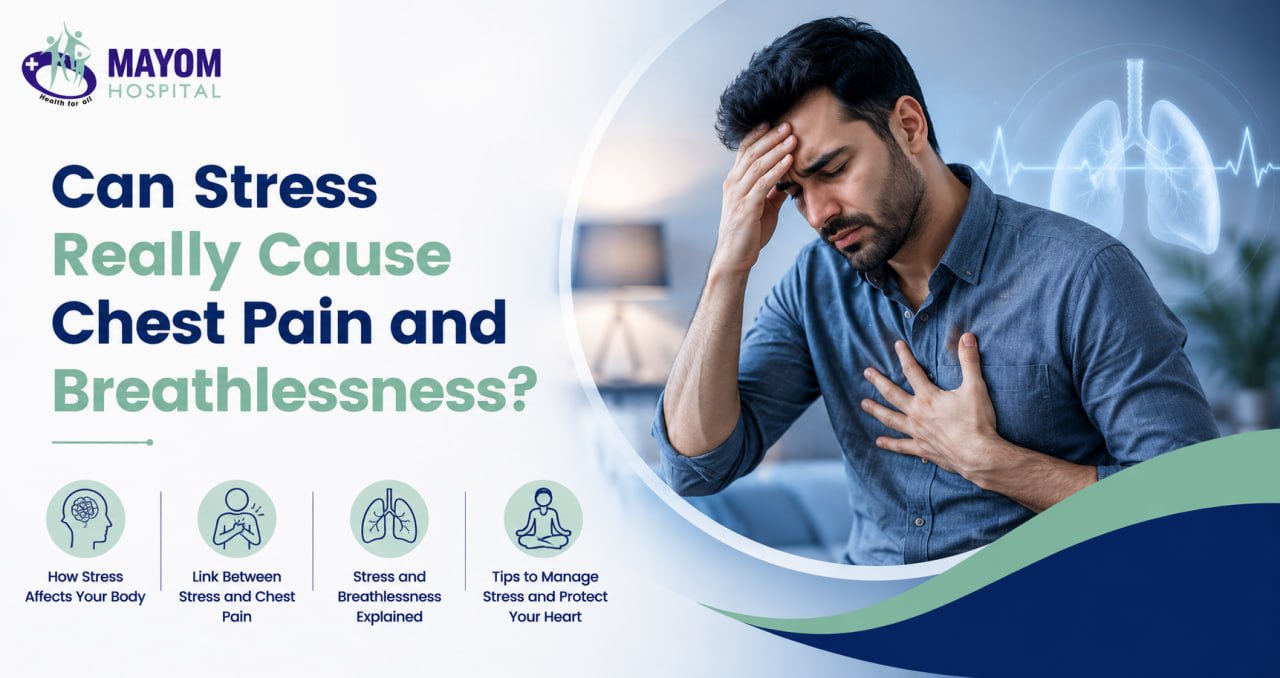
Can Stress Really Cause Chest Pain and Breathlessness?
Your heart suddenly races. Your chest feels tight. Taking a full breath seems strangely difficult.
Then comes the thought most people have in that moment: Is something wrong with my heart?
Sometimes, stress really can cause chest pain and breathlessness. The body doesn't neatly separate emotional pressure from physical danger. When you're anxious, worried, angry, or overwhelmed, your brain can switch on the body's “fight-or-flight” response, releasing hormones such as adrenaline. Your heartbeat speeds up. Your muscles tense. Your breathing can become faster and shallower.
And yes, that can feel frightening.
But here's the important part: chest pain should never automatically be blamed on stress. Heart problems, lung conditions, acid reflux, muscle strain and other medical issues can produce similar symptoms. Knowing the difference matters.
How Stress Can Trigger Chest Pain
Think about what happens when you're under pressure. Maybe you've spent six hours dealing with deadlines, skipped lunch, had too much coffee, and then received one more difficult phone call. Your shoulders tighten. Your jaw clenches. Your breathing changes.
That physical response can create chest discomfort.
Stress may cause muscle tension around the chest and upper body. It can also increase your heart rate and make you more aware of every heartbeat. In some people, anxiety triggers hyperventilation—breathing faster than the body actually needs—which can produce chest tightness, dizziness, tingling and a feeling that you simply can't get enough air.
Uncomfortable? Absolutely.
Dangerous every time? No.
But assuming it's “just anxiety” without getting checked can be a risky gamble.
Why Does Breathlessness Happen During Stress?
Breathlessness caused by anxiety can feel surprisingly physical. There's no imaginary button being pressed. Your body is genuinely reacting.
During a stressful episode, you may start taking quick, shallow breaths. This can alter the balance of oxygen and carbon dioxide in your bloodstream, leading to sensations such as light-headedness, tingling around the fingers or lips, chest tightness and difficulty taking a satisfying deep breath.
The frustrating part is the feedback loop.
You feel breathless, so you become scared. Fear makes you breathe faster. Faster breathing makes the sensation stronger. Suddenly, a few minutes of stress feel like a medical emergency.
Sometimes, though, they are a medical emergency.
When Chest Pain Needs Immediate Attention
Don't wait for the pain to “settle down” if it is severe, sudden or unfamiliar.
Seek urgent medical attention if chest pain is accompanied by:
- Pressure, squeezing or heaviness in the chest
- Pain spreading to the arm, shoulder, jaw, neck or back
- Severe or sudden breathlessness
- Cold sweating
- Fainting or extreme weakness
- Persistent nausea or vomiting
- A rapid or irregular heartbeat
These symptoms can occur with serious heart or other medical conditions. Women and older adults may sometimes experience less typical symptoms, so relying only on the classic “crushing chest pain” image isn't wise.
How Can You Tell If Stress Is the Cause?
You usually can't diagnose the cause by sensation alone.
A doctor may ask about when the pain begins, how long it lasts, what triggers it, whether it occurs during physical activity, and whether you have risk factors such as diabetes, high blood pressure, high cholesterol, smoking or a family history of heart disease.
Depending on the situation, evaluation may include blood pressure measurement, an ECG, blood tests, echocardiography or other cardiac investigations.
This is where seeing an experienced Chest Specialist in Gurgaon can provide clarity rather than guesswork.
Managing Stress-Related Symptoms
If your doctor rules out a serious medical cause, then stress management becomes part of the treatment—not an optional wellness slogan.
Try slow breathing. Walk for 15–20 minutes. Cut back on excessive caffeine. Maintain regular sleep. Take short breaks when your workday becomes one long, uninterrupted sprint.
And pay attention to patterns.
Does the chest tightness appear before presentations? During arguments? After several nights of poor sleep? Those clues can help you and your doctor understand what's happening.
Why Choose Mayom Hospital for Heart and Chest Care?
For recurring chest discomfort or unexplained breathlessness, timely evaluation matters. Mayom Hospital provides specialist-led cardiac and chest care, supported by diagnostic facilities that help doctors investigate symptoms properly rather than simply treating the obvious complaint.
Patients looking for the Best Cardiology Treatment in Gurgaon or the Best Heart Hospital in Gurgaon can seek expert assessment based on their individual symptoms and medical history.
Because sometimes the answer really is stress.
Sometimes it isn't.
And when your chest is involved, finding out which one you're dealing with is worth the appointment.