
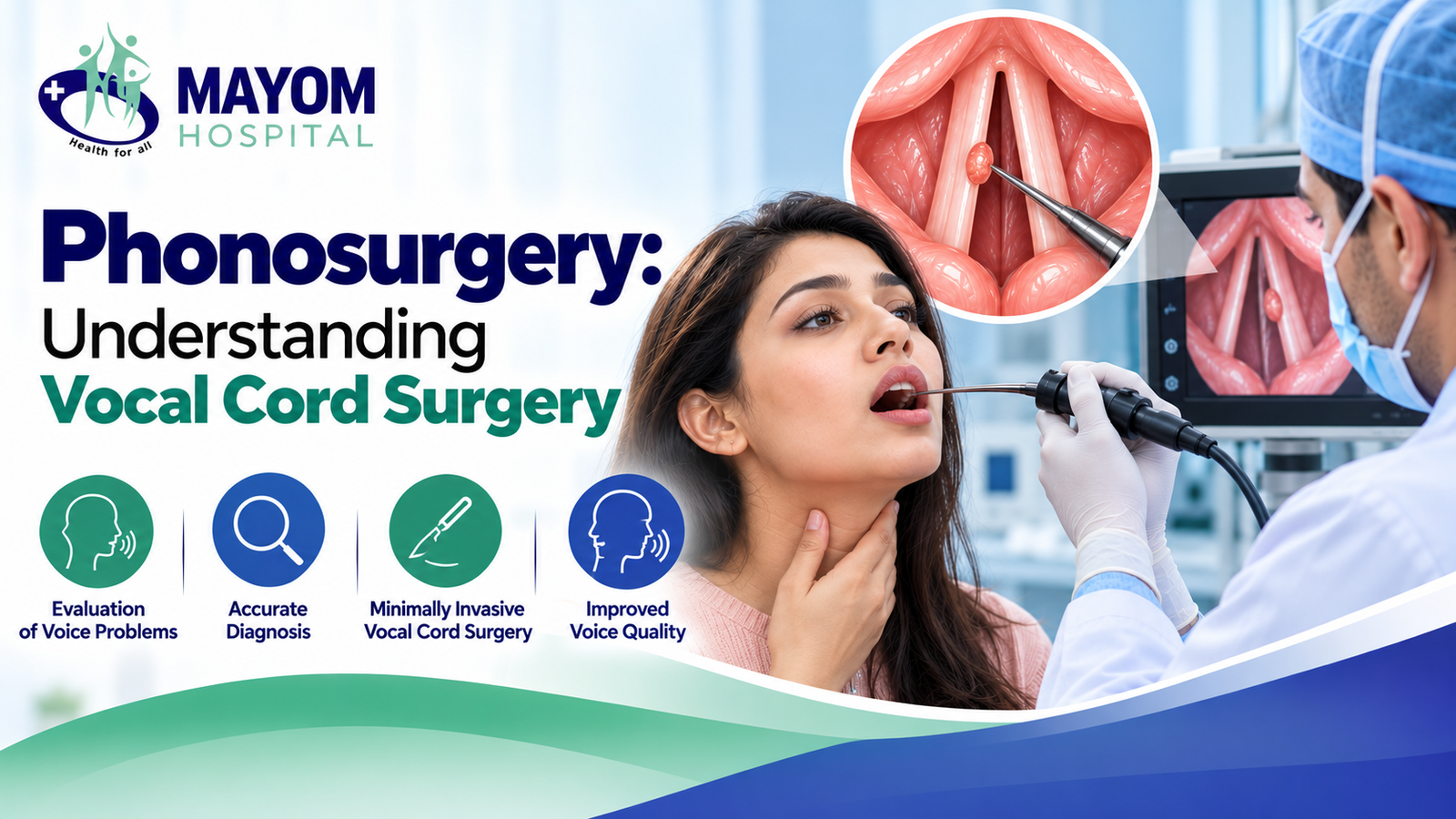
Phonosurgery: Understanding Vocal Cord Surgery
Your voice is something you rarely think about until it changes. Persistent hoarseness, a weak or breathy voice, or a voice that tires after a few minutes of talking can affect work, relationships and confidence. In some cases, these problems need more than rest and medicines. That is where phonosurgery comes in.
What Is Phonosurgery?
Phonosurgery is a group of surgical procedures performed on the larynx (voice box) and vocal cords. Its goal is not only to remove disease but also to improve, restore or preserve the quality of the voice. It is carried out by ENT and head-neck surgeons, usually with specialised microscopes, endoscopes and fine instruments, working with extreme precision because the vocal cords are only a few millimetres thick.
How Do Vocal Cords Produce Sound?
The two vocal cords sit side by side in the larynx. When you speak, they come together and vibrate hundreds of times per second as air passes between them. For a clear voice, the cords need to be smooth, flexible and able to close fully. Anything that makes them stiff, swollen, uneven or unable to close can change the voice.
Conditions Treated with Phonosurgery
- Vocal cord nodules – small callus-like growths, common in teachers, singers and people who use their voice heavily
- Vocal cord polyps and cysts – growths or fluid-filled swellings that cause hoarseness or a double-toned voice
- Reinke's edema – swelling of the cords, often linked to smoking
- Vocal cord paralysis or weakness – when one or both cords do not move properly, causing a breathy voice, choking on liquids or shortness of breath
- Laryngeal papillomas – wart-like growths caused by viral infection
- Leukoplakia and suspicious lesions – white or red patches that may need biopsy to rule out early cancer
- Vocal cord scarring – after injury, surgery, or prolonged intubation
When Is Phonosurgery Considered?
Most voice problems are treated first with voice rest, hydration, treatment of reflux or allergies, and voice therapy with a speech-language pathologist. Surgery is usually considered when:
- Hoarseness lasts more than 3–4 weeks and does not improve with conservative treatment
- A growth, cyst or polyp is seen on examination
- A lesion looks suspicious and needs a biopsy
- A vocal cord is paralysed or does not close properly
- The voice problem seriously affects daily life or a person's profession
How Is the Problem Diagnosed?
Before recommending surgery, the ENT specialist will usually carry out:
- A detailed history of your voice use, habits, smoking, reflux and past surgeries
- Laryngoscopy (flexible or rigid) to look directly at the vocal cords
- Videostroboscopy, which uses a flashing light to show the vibration pattern of the cords in slow motion
- Imaging or other tests when needed, especially for paralysis or suspected tumours
Common Types of Phonosurgery
Microlaryngeal surgery: Through the mouth, using a microscope and fine instruments (or sometimes a laser), the surgeon removes nodules, polyps, cysts or abnormal tissue while protecting the healthy layers of the cord. No external cut is needed.
Injection laryngoplasty: A filler material is injected into a weak or paralysed vocal cord to add bulk so the cords can meet properly. It can sometimes be done under local anaesthesia.
Medialization thyroplasty: An implant is placed through a small neck incision to push a paralysed cord towards the centre, improving voice and swallowing.
Other procedures: Depending on the case, options include arytenoid adduction, reinnervation procedures and surgery for scar release.
The right procedure depends on the exact diagnosis, your voice needs and your overall health.
What to Expect Before and After Surgery
Microlaryngeal procedures are usually done under general anaesthesia and are often day-care or need a short hospital stay. After surgery:
- Voice rest is advised for a period decided by your surgeon, often several days to about two weeks
- Avoid whispering, shouting, throat clearing and smoking
- Stay well hydrated and take medicines as prescribed
- Post-operative voice therapy helps the voice heal well and prevents the problem from returning
- Follow-up laryngoscopy checks healing
Voice quality often keeps improving over several weeks as swelling settles.
Risks and Limitations
Like any surgery, phonosurgery has risks, such as bleeding, infection, scarring, temporary or lasting voice changes, and the possibility of the problem returning if voice habits do not change. Your surgeon will explain these in detail. Good outcomes depend on correct diagnosis, careful technique and your commitment to voice rest and therapy.
Protecting Your Voice
- Drink enough water through the day
- Avoid smoking and limit alcohol and caffeine
- Do not shout or strain your voice, especially when you are unwell
- Treat acid reflux, allergies and sinus problems
- Take regular breaks if you speak or sing for long hours
When Should You See an ENT Specialist?
Do not ignore these signs:
- Hoarseness lasting more than 3-4 weeks
- Loss of voice without a clear cause
- Pain while speaking or swallowing
- Difficulty breathing or noisy breathing
- Coughing up blood
- A lump in the neck
- Choking while drinking liquids
Early evaluation helps find the cause quickly, and in many cases simple treatment is enough.
Conclusion
Phonosurgery offers effective options for many voice disorders, from small growths to vocal cord paralysis. With the right diagnosis, a skilled surgeon and proper voice care afterwards, most people see a clear improvement in how their voice sounds and feels. If your voice has been changing for weeks, an ENT check-up is the best first step.