
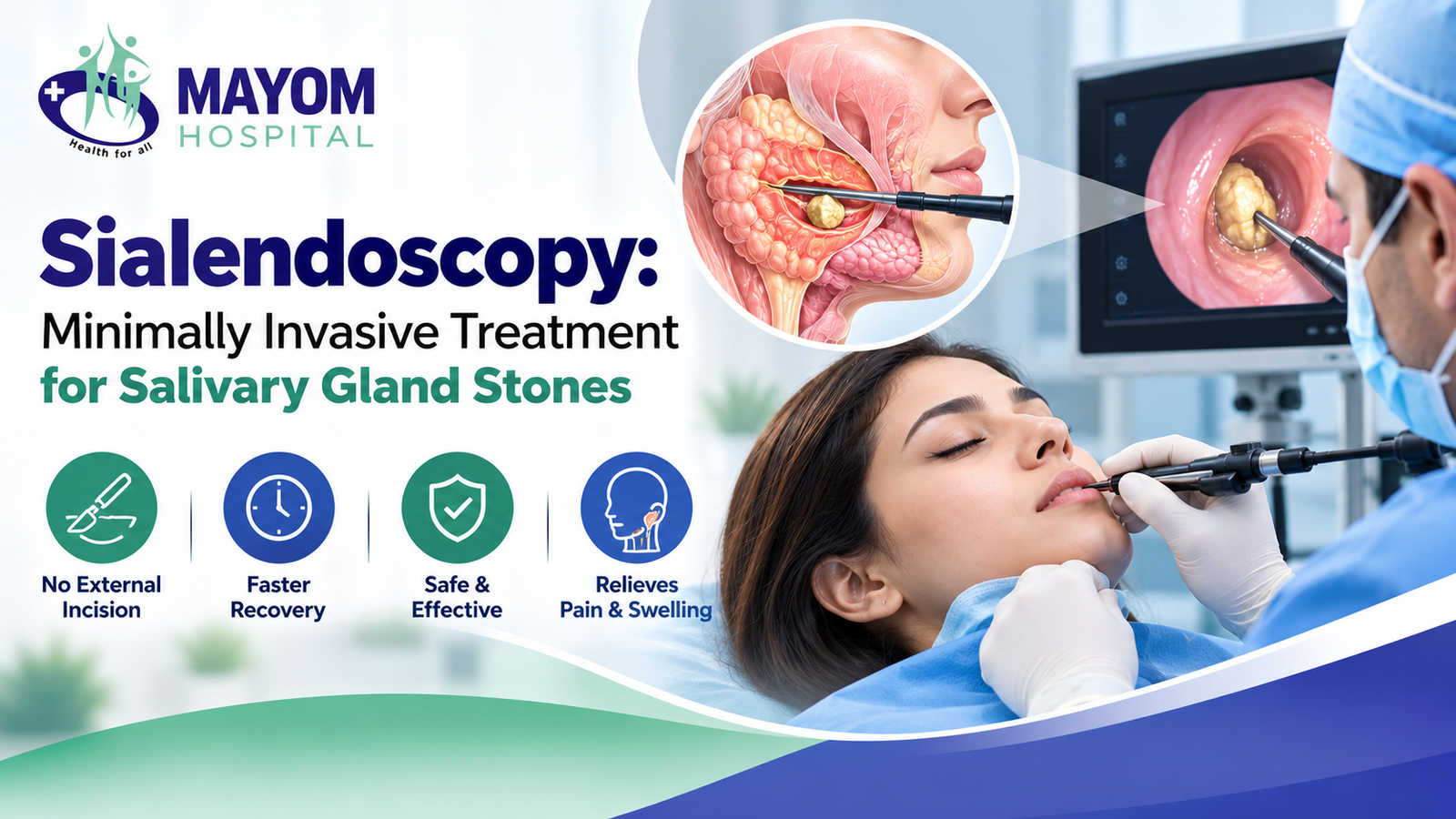
Sialendoscopy: Minimally Invasive Treatment for Salivary Gland Stones
Many people with a salivary gland stone first notice it at a meal. You sit down to eat, and within minutes the area under your jaw or in your cheek swells up and starts to hurt. Half an hour later it settles, and you forget about it, until the next meal. After a few weeks of this, you start to worry.
A salivary gland stone is a common and treatable problem. In the past, a stubborn one could mean removing the whole gland. Today, sialendoscopy lets an ENT surgeon look inside the salivary duct with a tiny camera and often remove the stone through the mouth, keeping the gland. This guide explains how it works, who it suits, and what recovery looks like.
What Are Salivary Glands?
You have three pairs of major salivary glands that make saliva to help you chew, swallow, taste, and protect your teeth:
- Parotid glands: in the cheeks, in front of the ears
- Submandibular glands: under the jaw
- Sublingual glands: under the tongue
Each gland drains saliva through a thin tube called a duct that opens inside your mouth. Blockage anywhere along this path causes saliva to back up.
What Are Salivary Gland Stones?
A salivary gland stone (sialolithiasis) is a small, hard lump of minerals that forms inside a salivary gland or duct. It can be as small as a grain of sand or larger. Most stones form in the submandibular gland. The parotid gland is the next most common site, and many people have more than one stone.
A stone causes no symptoms while it forms. Trouble starts when it grows enough to block the duct. Saliva then backs up into the gland, causing pain and swelling, and the trapped saliva can become infected.
Causes and Risk Factors
The exact cause is not fully understood, but stones are more likely when saliva is reduced or thick. Factors include:
- Dehydration, which is common in hot, dry weather and air-conditioned rooms across Delhi NCR
- Medicines that dry the mouth, such as some antihistamines, antidepressants, and blood pressure tablets. Do not stop any medicine without your doctor's advice.
- Previous infection or injury of the gland
- Narrowing (stricture) of the duct from scarring or inflammation
- Smoking, and some conditions that affect the glands
Symptoms of a Salivary Gland Stone
- Pain and swelling under the jaw or in the cheek, often at mealtimes or when you smell or think of food
- Swelling that settles after an hour or so, and then comes back
- A hard lump you can feel under the tongue or inside the cheek
- A bad taste in the mouth, or pus coming from the duct opening
- Dry mouth
- Redness, warmth, fever, and tenderness when the gland is infected
Not every swelling is a stone
Swelling in the cheek or neck can also come from an infection, inflammation, or a growth, and these need a different approach. See an ENT doctor if the swelling is hard, painless, growing, or does not go away, or if it comes with facial weakness or numbness.
Get urgent care if:
- You have fever with a red, hot, painful swelling under the jaw or in the cheek
- The swelling spreads to the floor of the mouth or neck, or you have trouble swallowing or breathing
How Is It Diagnosed?
Diagnosis usually starts in the clinic:
- History and examination: Your doctor asks when the swelling comes and goes, then examines the mouth and feels the gland and duct for a stone.
- Ultrasound: A simple, painless scan that detects many stones and shows the gland. Mayom Hospital offers ultrasound.
- CT scan: Used when a stone is small or not seen on ultrasound, or when the doctor needs to look at the surrounding area. A CT scan facility is available on site.
- Sialendoscopy itself: Besides treating, the scope also lets the surgeon look directly inside the duct to find stones, narrowing, or plugs.
Treatment Options for Salivary Gland Stones
1. Simple measures (for small stones)
- Drinking plenty of water
- Warm compresses over the gland
- Gentle massage of the gland towards the mouth
- Sucking on sour sweets or lemon to boost saliva flow, if your doctor says it is safe
- Medicines for pain and swelling, and antibiotics if there is an infection, only as prescribed
Never try to dig the stone out yourself, because this can injure the duct.
2. Sialendoscopy (for stones that do not pass)
A minimally invasive procedure that treats the stone from inside the duct. Details below.
3. Combined approaches
Larger stones or stones lodged deep in the gland may need sialendoscopy together with a small cut inside the mouth, or another technique to break the stone first.
4. Open surgery (removal of the gland)
This is now needed in fewer cases. It is considered when stones keep coming back, when the stone is too large or too deep to reach, or when the gland has been permanently damaged.
What Is Sialendoscopy?
Sialendoscopy is an endoscopic procedure in which the surgeon passes a very thin scope, thinner than a pencil lead, through the natural opening of the salivary duct inside your mouth. A tiny camera at the tip sends live images to a screen.
Because it works through the mouth, it is both a diagnostic and a treatment tool. Through the scope, the surgeon can:
- See the duct and find stones, narrowings, kinks, and plugs
- Remove stones with fine baskets or forceps
- Widen narrowed areas
- Wash the duct and, if needed, deliver medicine such as steroids to calm inflammation
How the procedure is done
- Anaesthesia: Many cases can be done under local anaesthesia, sometimes with sedation. General anaesthesia may be used for complex cases or if you prefer. Your surgeon will advise.
- Finding the duct opening: The surgeon gently widens the tiny opening of the duct inside your mouth.
- Entering the duct: The scope is passed into the duct to look for the stone and the cause of blockage.
- Treating the problem: The stone is removed or the duct is opened and cleared.
- Finishing: Sometimes a small soft tube (stent) is left in the duct briefly to help it stay open while it heals.
The time varies from about half an hour to a couple of hours, depending on how complex the case is, and many patients go home the same day.
Who Is a Good Candidate for Sialendoscopy?
Sialendoscopy suits many people with:
- Recurrent pain and swelling of a salivary gland at mealtimes
- A confirmed or suspected stone in the duct
- A narrowing (stricture) or mucus plug in the duct
- Repeated gland infections, where the duct needs to be examined
It may not be enough on its own when a stone is too large, stuck deep inside the gland, or when the gland is badly scarred. In those cases your surgeon may recommend a combined approach or surgery.
Sialendoscopy vs Open Gland Surgery
| Sialendoscopy | Open surgery (gland removal) | |
|---|---|---|
| Approach | Through the natural opening of the duct in the mouth | Cut under the jaw or in front of the ear |
| Gland | Usually preserved | Removed |
| External scar | Usually none | Yes |
| Anaesthesia | Local or general, depending on the case | General |
| Recovery | Usually quicker | Longer |
| Best for | Stones and narrowings reachable through the duct | Very large or deep stones, repeated problems, or a damaged gland |
| Main limits | Not every stone can be reached | Needs a larger operation, with different risks (for example, nerve injury near the gland) |
Recovery After Sialendoscopy
Recovery is usually easy, but it depends on what was done.
- First few days: Mild swelling or soreness in the area, sometimes some tenderness in the mouth
- Eating: A soft diet at first, then normal food as comfort allows
- Hydration: Drink plenty of fluids to keep saliva flowing
- Medicines: Take pain relief, steroids, or antibiotics only as prescribed
- Gland care: Your surgeon may advise gentle gland massage and measures to boost saliva flow
- Follow-up: Needed to check healing, and to remove a stent if one was placed
Most people return to routine activities within a few days. Your surgeon will tell you what is right for you.
Risks and Complications
Sialendoscopy is considered a safe procedure, but no procedure is risk free. Possible problems include:
- Temporary swelling of the gland, which is the most common
- Infection
- Narrowing or scarring of the duct
- Bleeding
- Temporary numbness or tingling of the tongue (rare)
- Stone not fully removed, needing another procedure
- Rarely, a need for a larger operation or removal of the gland
Your surgeon should explain which risks apply in your case.
Can Salivary Stones Come Back?
They can. Some people form stones again, especially if the cause (dry mouth, dehydration, a narrowed duct) continues. To lower the chance:
- Drink enough water through the day, particularly in summer
- Keep your mouth moist if you take drying medicines, and ask your doctor about options
- Do not ignore recurring swelling, and get a check-up early
- Keep up good oral hygiene
Sialendoscopy at Mayom Hospital, Gurgaon
Sialendoscopy is among the minimally invasive services of the ENT & Head-Neck Surgery department at Mayom Hospital, D-Block, South City 1, Gurgaon. To work out whether a salivary stone is behind your symptoms, the team can combine:
- A detailed ENT examination
- Ultrasound and CT scan on site
- A clear discussion of options, from simple measures to sialendoscopy and, only if needed, surgery
You can consult Dr. Manish Prakash (ENT, Head & Neck Surgery) for an evaluation of recurrent swelling under the jaw or in the cheek. Read more on our sialendoscopy page.
? Book an appointment: +91 9999469769
? Address: Mayom Hospital, D-Block, South City 1, Gurgaon
? Emergency (24×7): 0124-4212500
Questions to Ask Your Doctor
- Where is the stone, and how big is it?
- Can it be removed with sialendoscopy, or do I need another approach?
- What type of anaesthesia will I need?
- What is the chance that the gland can be preserved?
- What are the risks in my case?
- What care and follow-up will I need?
What Does Sialendoscopy Cost?
The cost depends on the type of procedure, the anaesthesia, whether other techniques are combined, tests, and your insurance or TPA. After an examination and scan, the hospital can give you a clear estimate. Check the empanelments page for insurer details.
Frequently Asked Questions (FAQs)
1. What is sialendoscopy?
Sialendoscopy is a minimally invasive procedure in which an ENT surgeon passes a very thin scope with a camera into the salivary duct through the mouth. It is used to find and remove stones, clear plugs, and treat narrowings.
2. Is sialendoscopy painful?
It is done under local anaesthesia (sometimes with sedation) or general anaesthesia, so you should not feel pain during the procedure. Afterwards, mild soreness and swelling are common and can be managed with prescribed medicines.
3. Can salivary gland stones go away on their own?
Small stones sometimes pass on their own with fluids, warm compresses, massage, and saliva stimulation. Stones that keep causing pain or swelling usually need an ENT evaluation and treatment.
4. Do I need surgery for a salivary gland stone?
Not always. Many stones are treated with simple measures or sialendoscopy. Surgery to remove the gland is needed only when stones are too large or deep, keep returning, or the gland is damaged.
5. How long does sialendoscopy take?
From about half an hour to a couple of hours, depending on the stone and the technique. Your surgeon can give you an estimate for your case.
6. How long is recovery after sialendoscopy?
Most people return to routine activities within a few days, with mild swelling or soreness that settles. Your surgeon will advise on diet, hydration, gland massage, and follow-up.
7. Will I lose my salivary gland?
Sialendoscopy aims to keep the gland. Removal is rarely needed, mainly when a stone cannot be reached or the gland is permanently damaged.
8. Can salivary stones come back?
Yes, in some people. Staying hydrated, managing dry mouth, and getting early treatment for recurring swelling help lower the risk.
9. Which doctor should I see for a salivary gland stone in Gurgaon?
An ENT / head and neck surgeon. At Mayom Hospital, you can book a consultation with Dr. Manish Prakash.
10. How much does sialendoscopy cost in Gurgaon?
The cost depends on the procedure type, anaesthesia, tests, and your insurance or TPA. After an examination and scan, the hospital can give you a clear estimate.
Final Thoughts
A swelling that comes and goes with meals is your body's clue that a salivary duct may be blocked. You do not have to put up with it, and you usually do not need to lose the gland. With a proper examination and, when needed, sialendoscopy, most salivary stones can be treated through the mouth, without a cut on the face or neck.
If the swelling keeps coming back, get it checked early. It is easier to treat before repeated infections damage the gland.