
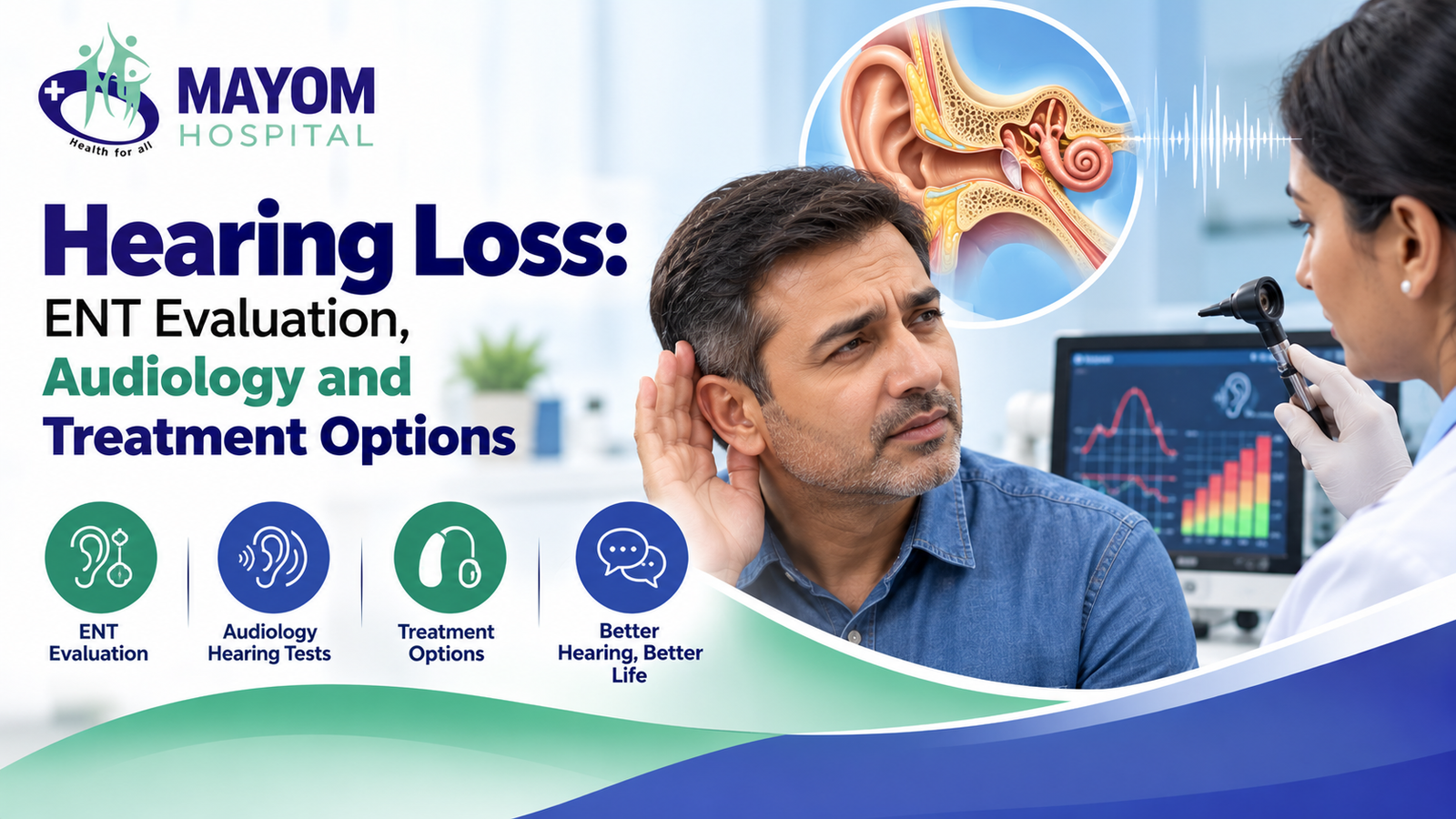
Hearing Loss: ENT Evaluation, Audiology and Treatment Options
Hearing loss means you cannot hear sounds as well as before, and it can happen at any age. It is divided into conductive (a problem in the outer or middle ear), sensorineural (a problem in the inner ear or hearing nerve) and mixed. Many conductive causes, such as ear wax, fluid, infection or a perforated eardrum, can be treated or even fully corrected. Sensorineural loss is usually permanent but can be managed very well with hearing aids or implants. The key is to find the cause early with an ENT examination plus an audiology (hearing) test. Sudden hearing loss is an emergency: see an ENT specialist within a day or two, not after weeks.
How Hearing Works
Sound travels through the outer ear to the eardrum, which moves three tiny bones in the middle ear. These pass the vibration to the cochlea in the inner ear, where thousands of delicate hair cells convert it into electrical signals. The hearing nerve then carries these signals to the brain, which turns them into meaning. A problem at any step can cause hearing loss, and where the problem lies decides the treatment.
Types of Hearing Loss
| Type | Where the problem is | Common causes | Outlook |
|---|---|---|---|
| Conductive | Outer or middle ear | Wax, ear infection, fluid behind the eardrum, eardrum hole, otosclerosis, cholesteatoma | Often treatable or correctable |
| Sensorineural | Inner ear or hearing nerve | Ageing, noise, viral infection, ototoxic medicines, genetics, Ménière's disease, nerve tumours | Usually permanent; managed with hearing aids or implants |
| Mixed | Both | A combination of the above | Treat the conductive part first, then support the rest |
Hearing loss can also be one-sided or both-sided, sudden or gradual, and present from birth (congenital) or acquired later. Each of these clues helps your doctor narrow down the cause.
Degrees of Hearing Loss
Audiologists measure how soft a sound you can just hear, in decibels (dB HL). Using World Health Organization grades for the better ear:
| Degree | Hearing level | What you may struggle with |
|---|---|---|
| Normal | Below 20 dB | Nothing significant |
| Mild | 20-34 dB | Whispers, conversation in noisy places |
| Moderate | 35-49 dB | Normal conversation without help |
| Moderately severe | 50-64 dB | Everyday speech; only loud speech is heard |
| Severe | 65-79 dB | Most speech; only loud sounds are heard |
| Profound | 80-94 dB | Almost all speech |
| Complete | 95 dB or more | Essentially no hearing |
Warning Signs of Hearing Loss
- Asking people to repeat themselves, or thinking everyone mumbles
- Turning the TV or phone volume up higher than others like
- Trouble following conversation in restaurants, markets or meetings
- Difficulty on phone calls
- Ringing or buzzing in the ears (tinnitus)
- Feeling tired after listening, or withdrawing from social situations
- A feeling of fullness or blockage in the ear
In children, watch for not responding to loud sounds, delayed or unclear speech, not reacting when called from behind, or turning the TV up very loud. In older adults, hearing loss often creeps in so slowly that family notices before the person does.
Common Causes
Conductive causes
- Ear wax blocking the canal
- Middle-ear infection or fluid, especially in children
- Perforated eardrum from infection or injury. Long-standing ear discharge (chronic otitis media) is common in India.
- Cholesteatoma, an abnormal skin growth in the middle ear that can damage the hearing bones
- Otosclerosis, where the stapes bone becomes stiff
- Injury or foreign objects in the ear
Sensorineural causes
- Age-related hearing loss (presbycusis), which usually affects high-pitched sounds first
- Noise: loud music through earphones, factory or construction noise, traffic, and firecracker blasts, which can cause instant permanent damage
- Ototoxic medicines, such as some injectable antibiotics and cancer drugs
- Infections: mumps, measles, meningitis, and infections during pregnancy
- Head injury
- Ménière's disease (see our guide to Ménière's disease)
- Acoustic neuroma, a rare benign nerve tumour that typically causes hearing loss in one ear
- Diabetes, high blood pressure and genetics
- Sudden sensorineural hearing loss, where no cause is found in most cases
Red Flags: See an ENT Specialist Urgently If...
- You lose hearing suddenly, over hours to a few days, in one or both ears. Read more about sudden hearing loss.
- Hearing loss comes with vertigo. See also our guide to the ear balance problem.
- There is ear pain, pus or blood discharge, fever or weakness of the face.
- Hearing is falling in only one ear, especially with ringing or unsteadiness.
- Hearing loss follows a head injury or a loud blast.
- A baby or child is not responding to sound or is not developing speech.
Do not wait to see if sudden hearing loss "clears on its own". Wax or fluid are easy to rule out, but true sudden inner-ear hearing loss is time-sensitive, and early treatment gives the best chance of recovery.
ENT Evaluation: What Happens at Your Visit
- History: when it started, one ear or both, whether it came suddenly, ringing, dizziness, ear discharge, noise exposure, medicines, diabetes, family history.
- Ear examination: the ear canal and eardrum are examined with an otoscope, microscope or endoscope to check for wax, infection, fluid, a hole in the eardrum or cholesteatoma.
- Tuning-fork tests: simple bedside tests that give an early clue about conductive versus sensorineural loss.
- Nose and throat check: blocked nose, Eustachian tube problems or enlarged adenoids can affect the middle ear, especially in children.
- Hearing tests with the audiologist, explained below.
Audiology Tests for Hearing Loss
| Test | What it checks | When it is used |
|---|---|---|
| Pure-tone audiometry | The softest sounds you can hear at different pitches, through air and bone conduction. The result is an audiogram. | Almost everyone |
| Speech audiometry | How clearly you understand words, not just how loudly you hear | To judge real-life hearing and plan hearing aids |
| Tympanometry and acoustic reflex | Eardrum movement and middle-ear pressure | Fluid, eardrum problems, Eustachian tube issues |
| OAE (otoacoustic emissions) | Whether the cochlea's hair cells respond | Newborn screening, children |
| BERA / ABR | How the hearing nerve and brainstem respond, without needing you to respond | Babies, young children, uncooperative patients, suspected nerve problems |
| CT scan of the temporal bone | Middle-ear and hearing-bone structure | Cholesteatoma, chronic ear disease, surgical planning |
| MRI of the inner ear nerve | The hearing and balance nerve and the brain pathways | One-sided or sudden sensorineural loss, suspected tumour |
| Blood tests | Sugar, thyroid, cholesterol and others | When a general medical cause is suspected |
Not everyone needs every test. [Mayom to confirm which of these tests are available in-house.]
Treatment Options for Hearing Loss
Treatment depends on the type and cause.
Conductive hearing loss
- Wax: safe removal by an ENT specialist (microsuction, gentle irrigation or instruments). Do not use cotton buds, hairpins, ear candles or roadside ear cleaners, which can push wax deeper or injure the eardrum.
- Ear infection or fluid: ear drops or antibiotics when needed, plus treatment of nose allergies or sinus problems. In children with fluid lasting more than about three months along with hearing difficulty, small ventilation tubes (grommets) may be advised.
- Perforated eardrum: tympanoplasty (myringoplasty) repairs the eardrum and can improve hearing and reduce infections.
- Cholesteatoma or chronic ear disease: mastoid surgery removes the disease, and the hearing bones can often be reconstructed.
- Otosclerosis: stapedotomy replaces the stiff bone with a tiny prosthesis and has high success rates in experienced hands. A hearing aid is an alternative.
Sensorineural hearing loss
- Sudden hearing loss: early steroid treatment (as tablets or injected into the middle ear) is the main treatment, together with a search for any underlying cause.
- Permanent loss: no medicine or supplement can regrow damaged hair cells. Management focuses on devices and rehabilitation.
Devices for hearing loss
| Device | Who it helps | Notes |
|---|---|---|
Hearing aids (behind-the-ear, receiver-in-canal, in-the-ear) | Mild to severe sensorineural loss, and many mixed or conductive losses | Amplify and clarify sound. They improve hearing but do not restore normal hearing. Need proper fitting and programming. |
CROS / BiCROS aids | One-sided deafness | Pick up sound on the deaf side and send it to the better ear |
Bone-anchored hearing systems | Conductive or mixed loss, or one-sided deafness, where ear aids cannot be worn | Carry sound through the skull bone directly to the inner ear |
Middle-ear implants | Selected patients who cannot use standard hearing aids | Surgical option after specialist assessment |
Cochlear implants | Severe to profound sensorineural loss with limited benefit from well-fitted hearing aids | Bypass damaged hair cells and stimulate the nerve directly. Needs surgery and months of rehabilitation. |
Why treat hearing loss early? Untreated hearing loss can lead to isolation, poorer communication, depression and, according to large studies, a higher risk of memory and thinking decline. Research is still evolving on how much hearing aids reduce that risk, but staying connected and engaged is clearly better for health.
Auditory rehabilitation
Hearing devices work best with auditory training and speech therapy, especially in children and cochlear implant users. Assistive tools such as TV streamers, amplified phones and captioned calls can also help.
Hearing Loss in Babies and Children
Early detection changes outcomes. Newborns can be screened with OAE or BERA in the first weeks of life. International guidance suggests screening by 1 month, diagnosis by 3 months and starting treatment by 6 months, because the brain's ability to learn speech depends heavily on hearing in the early years. Children with delayed speech, repeated ear infections or ear discharge should always have their hearing tested. Eligible children may get support for cochlear implants through government schemes in India, and your hospital can guide you on current eligibility.
How to Protect Your Hearing
- Keep earphone volume at or below about 60% and take breaks.
- Wear earplugs or earmuffs around loud machinery, concerts or construction.
- Stay far away from firecrackers and avoid loud blasts, especially around Diwali.
- Treat ear infections and ear discharge promptly.
- Never put objects, oil drops or ear candles into the ear without medical advice.
- Ask your doctor about hearing risks before long-term use of medicines.
- Control diabetes and blood pressure.
- Get vaccinated (MMR and others per schedule).
- Get a baseline hearing check at around 50 if you have risk factors, or earlier if you notice any change.
Common Myths
- "Hearing loss only affects old people." It can affect anyone, including children and young adults using loud earphones.
- "Hearing aids make hearing worse or make you dependent." They do not damage hearing, and they work best when started early.
- "Ear drops or herbal oils restore hearing." No such product can reverse sensorineural loss.
- "One good ear is enough." One-sided loss causes trouble locating sound and following speech in noise.
- "If I can hear some sounds, I am fine." Hearing loss often affects clarity of speech, not just loudness.
- "Roadside ear cleaning is safe." It risks eardrum injury and infection.
Which Doctor Should You See?
You usually need both. An ENT specialist finds and treats the medical or surgical cause, and an audiologist measures your hearing and fits hearing devices. Start with an ENT consultation if there is pain, discharge, sudden loss, dizziness or one-sided loss.
Frequently Asked Questions
Is hearing loss reversible?
It depends on the cause. Conductive causes such as wax, fluid, infection or a perforated eardrum can often be treated or repaired. Permanent sensorineural loss cannot be reversed, but it can be managed very well with devices.
What are the first signs of hearing loss?
Asking people to repeat, difficulty following conversation in noise, turning the volume up, ringing in the ears and feeling that others mumble.
Which test confirms hearing loss?
Pure-tone audiometry, done with an audiologist, is the standard test. Speech audiometry, tympanometry and other tests add detail.
What is the difference between conductive and sensorineural hearing loss?
Conductive loss is a problem in the outer or middle ear and is often treatable. Sensorineural loss is a problem in the inner ear or hearing nerve and is usually permanent.
Can ear wax cause hearing loss?
Yes, wax blocking the canal can cause temporary hearing loss and a blocked feeling. It should be removed safely by a doctor.
Can sudden hearing loss recover?
Many people recover some or all of their hearing, and early treatment improves the odds. That is why it is treated as an emergency.
When do I need a hearing aid?
When hearing loss affects daily communication and cannot be corrected by medicine or surgery. An audiologist will advise based on your audiogram and speech test results.
Do hearing aids restore normal hearing?
No. They amplify and clarify sound and make communication much easier, but hearing in noisy places can still be difficult.
Can loud earphones cause permanent hearing loss?
Yes. Listening at high volume for long periods damages inner-ear hair cells, and that damage is permanent.
Key Takeaways
- Hearing loss is either conductive (often treatable), sensorineural (usually permanent but manageable) or mixed.
- Get both an ENT examination and an audiology test to find the cause and the degree.
- Sudden hearing loss is an emergency: see an ENT specialist within a day or two.
- Wax, fluid, perforated eardrums and otosclerosis can often be fixed with treatment or surgery.
- Hearing aids, bone-anchored systems and cochlear implants help permanent loss, and starting early gives better results.
- Protect your ears from loud noise, and never use cotton buds, ear candles or roadside cleaners.
Worried About Your Hearing?
Our ENT team at Mayom Hospital, D-Block, South City 1, Gurgaon can examine your ears, arrange hearing tests and guide you on treatment. Book an appointment or call +91 99994 69769. [Mayom to confirm: audiometry, BERA, hearing aid fitting and ear surgery services listed here.]
References (verify and link before publishing)
- World Health Organization. World Report on Hearing, 2021.
- Chandrasekhar SS et al. Clinical Practice Guideline: Sudden Hearing Loss (Update). Otolaryngol Head Neck Surg, 2019.
- Schwartz SR et al. Clinical Practice Guideline: Cerumen Impaction (Update). Otolaryngol Head Neck Surg, 2017.
- Rosenfeld RM et al. Clinical Practice Guideline: Tympanostomy Tubes in Children (Update). Otolaryngol Head Neck Surg, 2022.
- Joint Committee on Infant Hearing. Year 2019 Position Statement.
- Livingston G et al. Dementia prevention, intervention, and care: 2024 report of the Lancet standing Commission.