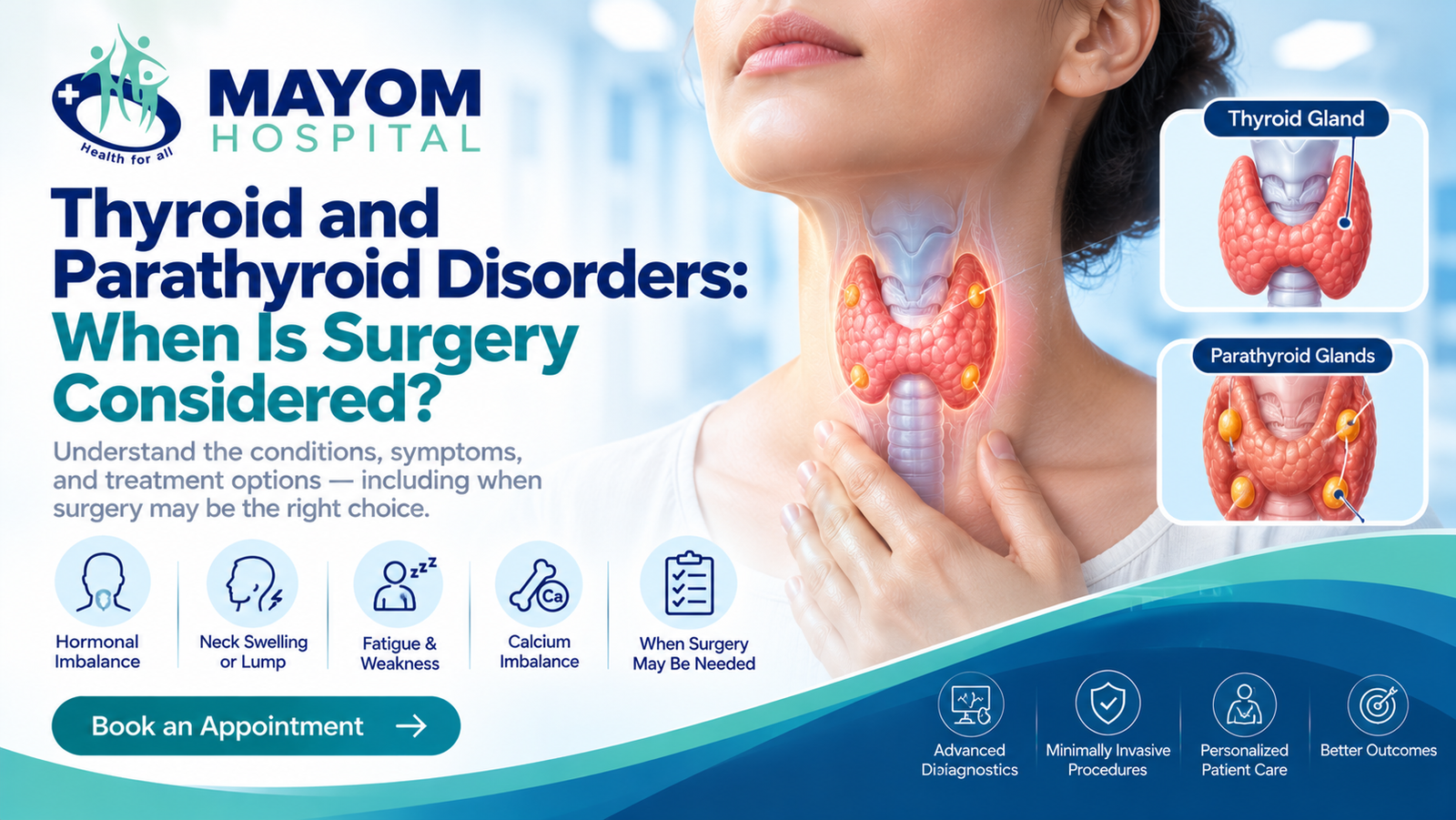
Thyroid and Parathyroid Disorders: When Is Surgery Considered?
A lump in the neck, an abnormal thyroid report, or a blood test showing high calcium can be unsettling. Many people jump straight to one question: "Will I need an operation?"
The honest answer is that most thyroid and parathyroid problems do not need surgery. Tablets, regular monitoring, and lifestyle care manage many of them. Surgery becomes the right choice only in specific situations. This guide explains what those situations are, how doctors decide, what the surgery involves, and what recovery looks like.
Thyroid and Parathyroid: What Do They Do?
The thyroid is a butterfly-shaped gland at the front of your neck. It makes hormones that control your metabolism: how fast your body uses energy, your heart rate, weight, body temperature, and mood.
The parathyroid glands are four tiny glands, each about the size of a grain of rice, sitting behind the thyroid. They control the calcium level in your blood, which matters for your bones, kidneys, muscles, and nerves.
The two are neighbours, and both lie close to the nerves that control your voice. That is one reason experience matters in neck surgery.
Common Thyroid and Parathyroid Disorders
Thyroid
- Hypothyroidism (underactive thyroid), often from Hashimoto's thyroiditis
- Hyperthyroidism (overactive thyroid), caused by Graves' disease or by a "toxic" nodule or goitre
- Goitre (goiter): an enlarged thyroid, sometimes with many nodules
- Thyroid nodules: lumps in the gland, most of them benign
- Thyroid cancer
Parathyroid
- Primary hyperparathyroidism: one or more glands become overactive and push calcium up. Usually one gland is the cause.
- Secondary hyperparathyroidism: the glands overwork because of another problem, most often chronic kidney disease
- Tertiary hyperparathyroidism: persistent overactivity that can remain after long-standing kidney disease or after a transplant
First, the Reassuring Part: Many Cases Do Not Need Surgery
| Condition | Usual first treatment |
|---|---|
| Hypothyroidism | Daily thyroid hormone tablet and regular blood tests |
| Mild hyperthyroidism | Anti-thyroid medicines, with monitoring |
| Small, benign-looking thyroid nodule | Watchful waiting with periodic ultrasound |
| Mild primary hyperparathyroidism without complications | Monitoring of calcium, bones, and kidneys |
| Secondary hyperparathyroidism | Medicines and treatment of the underlying kidney problem |
Surgery is considered when medicines are not enough, when cancer is possible or confirmed, or when the gland is causing damage or symptoms.
When Is Thyroid Surgery Considered?
1. A nodule is cancerous or suspicious for cancer
When a needle biopsy shows cancer, or looks suspicious, surgery is the main treatment. When the biopsy result is "indeterminate", surgery is sometimes the only way to get a definite answer.
2. Confirmed thyroid cancer
Surgery is the cornerstone of treatment for most thyroid cancers. Depending on the type and spread, it may involve removing the thyroid and nearby lymph nodes. Some patients need further treatment afterwards.
3. A large goitre pressing on the windpipe or food pipe
Difficulty swallowing, a feeling of tightness in the throat, breathlessness when lying down, or a changed voice can mean the goitre is compressing nearby structures. A very large or visible swelling may also be removed for comfort and appearance.
4. Hyperthyroidism that medicines cannot control
In Graves' disease, a toxic nodule, or a toxic multinodular goitre, surgery may be advised when:
- Medicines do not control the thyroid or cause side effects
- The condition returns after stopping medicines
- Radioactive iodine is not suitable
- The goitre is large, or there is a suspicious nodule alongside
- Graves' eye disease is present or the patient prefers a definitive treatment
5. A nodule that keeps growing
A nodule that grows over time, or that looks worrying on ultrasound, usually needs a biopsy and sometimes surgery.
6. Family history or genetic risk
A family history of medullary thyroid cancer or related genetic conditions may lead to early surgical evaluation.
7. A goitre extending behind the breastbone
A retrosternal goitre can press on the airway and often needs surgery.
When Is Parathyroid Surgery Considered?
For primary hyperparathyroidism, surgery is the only cure. Medicines can lower calcium or protect bones, but they do not remove the overactive gland. Guidelines suggest surgery when one or more of the following are present:
- Blood calcium clearly above normal (more than about 1 mg/dL above the upper limit)
- Bone problems: osteoporosis or a fracture
- Kidney problems: kidney stones, calcium deposits in the kidneys, high calcium in the urine, or reduced kidney function
- Age 50 or younger
- Symptoms such as fatigue, muscle weakness, or stomach problems that are linked to the condition
- When none of the above apply, surgery can still be chosen if the patient and the doctor agree and surgery is safe
Reported cure rates are high, above 95% in the hands of experienced surgeons.
Secondary and tertiary hyperparathyroidism (kidney-related): surgery is considered when medicines fail, or when calcium or phosphate levels and bone disease cannot be controlled. A severe, dangerous rise in calcium (hypercalcaemic crisis) is an emergency.
Symptoms to Watch For
| Gland | Possible symptoms |
|---|---|
| Thyroid lump or goitre | Swelling in the front of the neck, a visible lump that moves when swallowing, tightness, cough, difficulty swallowing or breathing, hoarse voice |
| Overactive thyroid | Weight loss, palpitations, sweating, tremor, anxiety, heat intolerance, poor sleep |
| Underactive thyroid | Tiredness, weight gain, cold intolerance, dry skin, constipation, low mood |
| Parathyroid | Kidney stones, bone pain or fractures, constant tiredness, muscle weakness, frequent urination and thirst, constipation, low mood, poor concentration |
Many people with parathyroid disease have no clear symptoms and are found by a routine blood test.
See a doctor soon if you notice:
- A neck lump that is growing, hard, or fixed
- Hoarseness lasting more than 2 to 3 weeks
- Difficulty swallowing or breathing
- Swollen glands in the neck along with a thyroid lump
- A family history of thyroid cancer, or past radiation to the neck
How Is It Diagnosed?
For the thyroid
- Clinical examination of the neck
- Blood tests: TSH, T3, T4, and sometimes antibodies
- Neck ultrasound, the best test to look at nodules. Mayom Hospital offers ultrasound.
- Needle biopsy (FNAC) from a nodule that looks suspicious or is large
- Scans such as a thyroid scan, CT, or MRI in selected cases, for example when a goitre extends into the chest. A CT scan facility is available on site.
- Vocal cord check before surgery, to know how your voice box is working
For the parathyroid
- Blood tests: calcium, parathyroid hormone (PTH), vitamin D, and kidney function
- 24-hour urine calcium
- Bone density scan (DEXA) and imaging for kidney stones
- Imaging to locate the overactive gland, such as ultrasound or a nuclear scan, done after the biochemical diagnosis is confirmed
Types of Surgery
Thyroid surgery
| Operation | What is removed | Typically used for |
|---|---|---|
| Hemithyroidectomy (lobectomy) | One half of the thyroid | A single nodule, low-risk disease, diagnosis of an indeterminate nodule |
| Total (or near-total) thyroidectomy | The whole gland | Most thyroid cancers, large multinodular goitres, Graves' disease, disease on both sides |
| With neck node removal | Thyroid plus lymph nodes | When cancer has spread to nodes |
Parathyroid surgery (parathyroidectomy)
| Operation | What happens | Typically used for |
|---|---|---|
| Focused (targeted) parathyroidectomy | Only the overactive gland is removed through a small cut | When imaging clearly shows a single gland |
| Bilateral neck exploration | The surgeon checks all four glands | When imaging is unclear or more than one gland may be involved |
Your surgeon will explain which operation fits your case and why.
What to Expect Before, During, and After Surgery
Before surgery
- Blood tests, a voice-box check, and an anaesthesia fitness check
- Overactive thyroid patients are usually brought to normal levels with medicines first
- Vitamin D and calcium levels may be checked and corrected
- You will be told which medicines to continue or stop
During surgery
- Done under general anaesthesia, usually taking one to a few hours
- A small cut in a natural skin crease of the neck
- The surgeon takes care to protect the voice nerves and the parathyroid glands. Ask whether nerve monitoring will be used.
- A small drain is sometimes placed
After surgery
- Hospital stay is usually short, often one to two days, depending on the operation
- Sore throat, a tight feeling in the neck, and a temporary hoarse voice are common
- Many people return to desk work within about one to two weeks, but this varies
- Avoid heavy lifting and strenuous exercise until your surgeon allows it
- The scar usually fades over months. Follow your surgeon's advice on scar care.
After total thyroidectomy you will need a daily thyroid hormone tablet, usually for life. After a lobectomy, some people need it and some do not, and blood tests will show.
After thyroid or parathyroid surgery, your calcium may dip for a while. Tingling around the mouth or in the fingers, or muscle cramps, need prompt attention. Tell your doctor straight away.
Risks and Complications
Thyroid and parathyroid surgery is well established and generally safe, but like any surgery it has risks:
- Bleeding in the neck, a rare but urgent problem. Swelling in the neck or breathing difficulty after surgery needs immediate help.
- Infection
- Voice changes from irritation or injury to the voice nerve, which is usually temporary and rarely permanent
- Low calcium because the parathyroid glands are affected, usually temporary and rarely permanent
- Scar in the neck
- Need for lifelong thyroid hormone after removal of the whole gland
- Persistent or returning parathyroid disease, in a small number of cases
- Risks of general anaesthesia
Surgeon experience matters in neck surgery. Ask about it, and ask which risks apply to you.
Questions to Ask Your Surgeon
- Why do I need surgery, and what are the alternatives?
- Which operation do you recommend, and why that one?
- What are the chances of voice change or low calcium in my case?
- Will I need thyroid tablets or calcium afterwards, and for how long?
- Will nerve monitoring be used?
- When can I go back to work and exercise?
- What will the biopsy or histopathology report mean for my next steps?
- What follow-up will I need?
Thyroid and Parathyroid Care at Mayom Hospital, Gurgaon
The ENT & Head-Neck Surgery department at Mayom Hospital, D-Block, South City 1, Gurgaon lists thyroid and parathyroid surgeries and head and neck cancer surgery among its services. The department works with the hospital's imaging, laboratory, and cancer care teams to support diagnosis and treatment:
- Neck ultrasound and CT scan on site
- Pathology and histopathology services to examine tissue and biopsy samples
- Diagnosis & biopsy support within cancer care
- Dedicated operation theatres for ENT and head-neck surgeries
You can consult Dr. Manish Prakash (ENT, Head & Neck Surgery) for an evaluation of a neck lump, thyroid problem, or parathyroid problem. Where you also need an endocrinologist's input, for example for hormone management, your surgeon can guide you.
? Book an appointment: +91 9999469769
? Address: Mayom Hospital, D-Block, South City 1, Gurgaon
? Emergency (24×7): 0124-4212500
What Does Thyroid or Parathyroid Surgery Cost?
The cost depends on the operation, whether neck nodes are also removed, the room category, tests, and your insurance or TPA. After your evaluation, the hospital can give you a clear estimate. You can check the empanelments page for insurer and TPA details.
Frequently Asked Questions (FAQs)
1. When is thyroid surgery needed?
Thyroid surgery is considered when a nodule is cancerous or suspicious, when thyroid cancer is confirmed, when a goitre is large or pressing on the windpipe or food pipe, or when an overactive thyroid cannot be controlled with other treatment.
2. Do all thyroid nodules need surgery?
No. The large majority of thyroid nodules are benign. Many only need monitoring with ultrasound. Surgery is advised when a nodule looks suspicious, grows, causes symptoms, or produces too much hormone.
3. Is thyroid surgery safe?
It is a well-established operation and is generally safe in experienced hands. Risks include bleeding, infection, voice changes, and low calcium. Your surgeon should explain which risks apply to you.
4. Will I need medicine for life after thyroid surgery?
After total thyroidectomy, yes, you need a daily thyroid hormone tablet for life. After removal of one half, some people need medicine and some do not, and blood tests will show.
5. How long is recovery after thyroid surgery?
Many people go home within one to two days and return to desk work in about one to two weeks. Heavy exercise and lifting need to wait until your surgeon allows. Recovery differs from person to person.
6. When is parathyroid surgery needed?
For primary hyperparathyroidism, surgery is the only cure. It is advised when calcium is clearly high, or when there are bone or kidney problems, or the patient is 50 or younger, or when symptoms are linked to the condition. In kidney-related hyperparathyroidism, it is considered when medicines fail.
7. Can hyperparathyroidism be treated without surgery?
Some medicines can lower calcium or protect the bones, and mild cases without complications can be monitored. But medicines do not remove the overactive gland, so surgery is the only cure.
8. Can thyroid surgery affect my voice?
The voice nerves lie right next to the thyroid. A temporary hoarse voice is common after surgery. Lasting voice change is rare, and careful technique and surgeon experience help lower the risk.
9. How much does thyroid surgery cost in Gurgaon?
The cost depends on the operation, additional procedures, room category, tests, and insurance or TPA. After your evaluation, the hospital can give you a clear estimate.
10. Which doctor should I see for a thyroid or neck lump in Gurgaon?
An ENT / head and neck surgeon or an endocrine surgeon, often together with an endocrinologist. At Mayom Hospital, you can book a consultation with Dr. Manish Prakash.
Final Thoughts
A thyroid or parathyroid diagnosis does not automatically mean surgery. For most people, tablets and monitoring are enough. Surgery makes sense when cancer is possible, when a gland is causing damage or pressure, or when medicines cannot control the problem, and in those cases it is usually very effective.
If you have a neck lump, an abnormal thyroid or calcium report, or symptoms that do not settle, get examined properly. A clear diagnosis lets you decide with confidence, rather than with fear.