
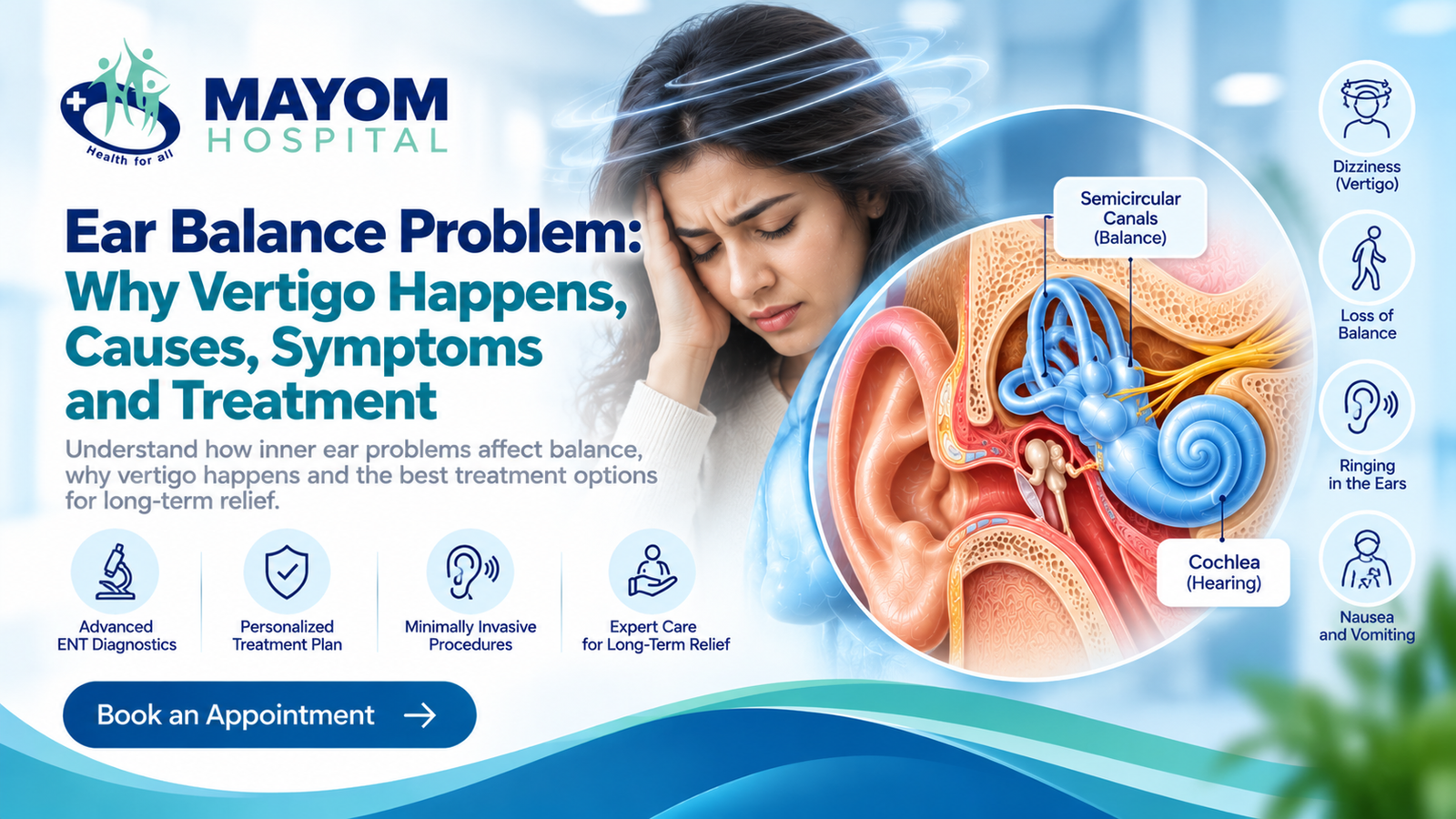
Ear Balance Problem: Why Vertigo Happens, Causes, Symptoms and Treatment
An ear balance problem (also called a balance disorder) means the motion sensors in your inner ear are sending your brain wrong or uneven signals. The usual result is vertigo, a false feeling that you or the room is spinning (chakkar aana), often with unsteadiness and nausea. The most common inner-ear cause is BPPV, caused by loose inner-ear crystals, and it is treated with a simple head-movement manoeuvre rather than tablets. Most ear-related causes are treatable. But vertigo with weakness, slurred speech, double vision or a sudden severe headache is an emergency and can be a stroke.
What Is an Ear Balance Problem?
"Ear balance problem" is an everyday term for any condition where the inner ear's balance system (the vestibular system) is not working properly. Doctors group these conditions as balance disorders.
It is not one disease. Vertigo, dizziness and unsteadiness are symptoms, and the real task is to find which condition is behind them. Dizziness is one of the most common reasons adults see a doctor, and many causes are very treatable once identified.
How Your Ears Keep You Balanced
Each inner ear has a balance organ with two parts:
- Three semicircular canals that sense head rotation (turning, nodding).
- Two otolith organs (utricle and saccule) that sense straight-line movement, tilt and gravity. They contain tiny calcium crystals called otoconia.
Both ears send signals through the vestibular nerve to the brainstem and cerebellum. Your brain combines these with information from your eyes and from the sensors in your muscles and joints to keep you steady and your vision stable when you move your head.
Why Does Vertigo Happen?
When both ears work normally, they send balanced signals. If one ear's signal suddenly becomes weaker, stronger or wrong, the brain receives a mismatch. It interprets this as rotation, even though you are still. Three things follow:
- You feel the spinning (vertigo).
- Your eyes make small, involuntary jerking movements (nystagmus), which is why vision may blur.
- The brainstem's links to the stomach trigger nausea, vomiting and sweating.
Vertigo comes from two broad places:
- Peripheral vertigo: the problem is in the inner ear or balance nerve. This is by far the most common type.
- Central vertigo: the problem is in the brain (for example the cerebellum or brainstem). This is less common but more serious.
Vertigo vs Dizziness vs Unsteadiness
| Feeling | What it means | Usual direction |
|---|---|---|
| Vertigo | A spinning or tilting sensation | Inner ear, balance nerve or brain |
| Lightheadedness | Feeling faint, "about to black out", especially on standing | Blood pressure, sugar, dehydration, anaemia, heart rhythm, medicines |
| Unsteadiness | Feeling off-balance while walking, without spinning | Inner ear, nerves, vision, ageing, brain |
Telling these apart is the first step, because they have different causes.
Ear Balance Problem Symptoms
- Spinning, tilting or swaying (vertigo)
- Unsteady walking, or feeling like you are on a rocking boat
- Nausea and vomiting
- Blurred or jumping vision when you move your head
- Dizziness when you roll over in bed, bend down or look up
- Fear of falling, avoiding crowds or travel
- Difficulty concentrating, especially in busy places
Vertigo ear symptoms: clues that the ear is involved
These point towards an inner-ear cause:
- Hearing loss in one ear, or hearing that comes and goes
- Ringing (tinnitus)
- A blocked or full feeling in the ear
- Ear pain or discharge
- Vertigo triggered by changing head position
Vertigo Causes: Common Ear Problems
| Cause | What it feels like | Typical clue | Usual treatment |
|---|---|---|---|
| BPPV | Short spins (under a minute) when you roll in bed, look up or bend | Hearing is normal; triggered by position | Canal-repositioning manoeuvre (Epley); tablets do not fix it |
| Vestibular neuritis | Sudden, continuous vertigo for hours to days, with nausea and imbalance | Hearing is normal; often follows a viral illness | Short-term symptom relief, sometimes steroids, early balance exercises |
| Labyrinthitis | Same as neuritis, plus hearing loss or ringing | New hearing drop makes it urgent | Urgent ENT care; treatment depends on cause |
| Ménière's disease | Attacks of 20 minutes to 12 hours with ear fullness, ringing and fluctuating hearing | Hearing symptoms in the same ear | Low-salt diet, trigger control, medicines; injections or surgery in stubborn cases |
| Vestibular migraine | Spinning or rocking lasting minutes to days | Migraine history; light or sound sensitivity; headache may be absent | Migraine-style trigger control and preventive medicines |
| PPPD | Constant swaying or rocking on most days for 3+ months | Worse in crowds, supermarkets, on screens or when upright | Vestibular rehabilitation, CBT, sometimes medicines |
| Ear infection or chronic ear disease | Vertigo with ear pain, discharge or hearing loss | Discharge or a perforated eardrum | Treat the infection; surgery for conditions such as cholesteatoma |
| Acoustic neuroma (rare) | Gradual one-sided hearing loss, ringing, unsteadiness | One-ear hearing loss with no clear reason | MRI; monitoring, radiosurgery or surgery |
A few more points:
- BPPV happens when the calcium crystals break loose and drift into a semicircular canal. It is more common with age and after a head injury, and it can come back.
- Ménière's disease is linked with a build-up of fluid pressure in the inner ear, but its exact cause is still not fully understood. Read more in our guide to Ménière's disease.
- Chronic ear infection matters in India because long-standing ear discharge can erode into the inner ear. Ear discharge with vertigo or hearing loss needs prompt ENT review. See also ear infection: causes and treatment.
- Medicines: some drugs (for example certain injectable antibiotics like gentamicin, some cancer drugs and high-dose diuretics) can injure the inner ear. Many others (BP tablets, sedatives, anti-epileptics) cause dizziness without harming the ear. Never stop a prescribed medicine on your own. Ask your doctor.
- Ageing and head injury can both damage balance organs or dislodge crystals.
Causes that look like an ear problem but are not
Low blood pressure on standing, low blood sugar, anaemia, dehydration, heart rhythm problems, anxiety or panic, new spectacles and side effects of medicines can all cause dizziness. A stroke or other brain problem can also cause vertigo, which is why red flags matter.
Red Flags: When Vertigo Is an Emergency
Go to an emergency department immediately (do not drive yourself) if vertigo comes with any of these:
- Weakness, numbness or drooping of the face, arm or leg
- Slurred speech or confusion
- Double vision or sudden loss of vision
- Inability to stand or walk even with support
- A sudden, severe headache or neck pain, especially after a neck injury
- Chest pain, palpitations or fainting
- Repeated vomiting so that you cannot keep fluids down
People with high blood pressure, diabetes, heart rhythm problems or who smoke are at higher stroke risk. Even vertigo that seems "ear-like" can be a stroke in them, and a trained doctor uses a bedside test called HINTS to tell the difference.
Sudden hearing loss in one ear, with or without vertigo, is also urgent. See an ENT specialist within a day or two, because early treatment improves the chance of recovery. Read more about sudden hearing loss.
Who Is at Higher Risk?
- People over 50 (BPPV and balance decline)
- Anyone with a recent head injury
- People with migraines
- Those with a recent viral illness or long-standing ear infection
- People on medicines that can affect the inner ear
- People with high blood pressure, diabetes or heart disease (for stroke-related causes)
How Doctors Diagnose an Ear Balance Problem
The history matters most. Your doctor will ask how long each episode lasts, what triggers it, and whether hearing or ear symptoms come with it. Then, depending on the picture:
- Bedside tests: the Dix-Hallpike or supine roll test for BPPV, eye-movement checks and HINTS for sudden continuous vertigo, plus a walking and standing balance assessment.
- Hearing tests: audiometry and tympanometry.
- Balance tests: videonystagmography (VNG), video head impulse test (vHIT) and other vestibular tests, when needed.
- MRI of the brain and inner-ear nerve: for one-sided hearing loss, neurological signs or when a central cause is suspected.
- Blood tests and blood pressure checks: sugar, haemoglobin, thyroid or others if lightheadedness is suspected.
Typical BPPV is diagnosed at the bedside. Guidelines advise against routine scans or balance-lab tests for it, so you do not need an MRI for every episode of vertigo.
Treatment: Treat the Cause, Not Just the Spin
- Repositioning manoeuvres (BPPV): the Epley manoeuvre and its variants move the crystals back to where they belong. Many people improve after one to a few sessions, but it can recur.
- Short-term medicines: anti-nausea and vestibular-suppressant tablets can help during a severe attack, but only for a few days. Used for longer, they can slow the brain's natural recovery and cause drowsiness. They do not cure BPPV.
- Vestibular rehabilitation therapy (VRT): a structured exercise programme that trains the brain to adapt. It helps after neuritis, in PPPD and in people with persistent imbalance.
- Cause-specific treatment: low-salt diet and medicines for Ménière's, migraine treatment for vestibular migraine, treating ear infections, and so on.
- Surgery: rarely needed. It is reserved for specific conditions such as cholesteatoma, acoustic neuroma or severe Ménière's that does not respond to other treatment.
What You Can Do at Home
- Move slowly: sit on the edge of the bed for a minute before standing.
- Use a night light and keep walkways clear, especially for older adults.
- Stay lightly active once the worst has passed. Long bed rest slows recovery.
- Avoid driving, climbing or working at heights during active episodes.
- If you have Ménière's, cut down salty foods such as pickles, papad, namkeen and instant noodles.
- If you have migraine-type vertigo, keep regular sleep and meal times and note your triggers.
- Stay hydrated and keep blood pressure and sugar under control.
Epley at home? Only after an ENT has confirmed which ear and canal are affected. Done in the wrong direction, it can fail or make things worse.
How Long Does Recovery Take?
| Condition | Typical course |
|---|---|
| BPPV | Each spell lasts seconds to a minute. It may settle on its own over weeks to months, but treatment is much faster. |
| Vestibular neuritis | Worst for the first few days, then improves over weeks as the brain adapts. Some people have lingering imbalance for months. |
| Ménière's disease | Long-term, with attacks that come and go. The aim is fewer attacks and protecting hearing. |
| Vestibular migraine | Episodes last minutes to days. Often improves with trigger control and prevention. |
| PPPD | Often needs months of rehabilitation. |
Common Myths
- "It's just weakness or low BP." Often it is neither. True spinning usually points to the ear or brain.
- "It's cervical spondylosis." This is a very common explanation in India, but it is rarely the real cause of true vertigo. Get your ears and balance checked first.
- "I need an MRI for every episode." Not for typical BPPV.
- "Bed rest will cure it." Prolonged rest slows recovery.
- "Vertigo tablets will cure it." They only calm symptoms.
- "A YouTube Epley is as good as a doctor's." Not unless the correct ear and canal are known.
Which Doctor Should You See?
See an ENT specialist (with an audiologist) if you have ear symptoms such as hearing loss, ringing, fullness or discharge, or if the vertigo is triggered by head position. A neurologist is involved if there are brain-related signs or a central cause is suspected. If you have any red flag above, go to an emergency department first.
Frequently Asked Questions
What causes ear balance problems?
The most common causes are BPPV, vestibular neuritis, labyrinthitis, Ménière's disease, vestibular migraine, ear infections, head injury, medicines and age-related decline of the balance system.
Can an ear infection cause vertigo?
Yes. A middle-ear infection can cause unsteadiness, and long-standing infection can spread to or erode into the inner ear, causing true vertigo. Ear discharge with vertigo or hearing loss needs prompt ENT care.
Is vertigo dangerous?
Most vertigo from the ear is not life-threatening, but it can cause falls, especially in older adults. Vertigo from a stroke is an emergency, so know the red flags.
Is vertigo curable?
Many causes are curable or very controllable. BPPV often resolves with repositioning, and neuritis improves as the brain adapts. Ménière's disease and vestibular migraine are managed long term.
How long does vertigo last?
It depends on the cause: seconds to a minute for BPPV, 20 minutes to 12 hours for Ménière's, hours to days for neuritis, and minutes to days for vestibular migraine.
Can vertigo affect hearing?
Some causes can. Ménière's disease, labyrinthitis and acoustic neuroma can cause hearing loss or ringing. BPPV and vestibular neuritis usually do not.
Can stress or anxiety cause balance problems?
Anxiety can cause dizziness and can worsen existing vertigo. Persistent postural-perceptual dizziness (PPPD) often starts after an inner-ear illness or a period of high anxiety.
Can I do the Epley manoeuvre at home?
Only after an ENT specialist confirms which ear and canal are affected and teaches you the technique.
Which test confirms an ear balance problem?
There is no single test. Diagnosis combines your history, bedside positional tests, hearing tests and, when needed, balance-lab tests or MRI.
Key Takeaways
- An ear balance problem is a symptom pattern, not one disease. Vertigo is its most striking symptom.
- Vertigo happens when the two inner ears send uneven signals and the brain reads them as spinning.
- BPPV is the most common inner-ear cause and is treated with a repositioning manoeuvre, not tablets.
- Hearing loss, ringing or ear discharge with vertigo points to the ear and needs ENT review.
- Weakness, slurred speech, double vision, severe headache or inability to walk with vertigo is an emergency.
- Do not stay on vertigo tablets for long, and do not rely on bed rest.
Need Help With Vertigo or Unsteadiness?
Our ENT team at Mayom Hospital, D-Block, South City 1, Gurgaon can assess your hearing and balance and plan treatment. Book an appointment or call +91 99994 69769. For red-flag symptoms, contact emergency care immediately.
References
- Bhattacharyya N et al. Clinical Practice Guideline: Benign Paroxysmal Positional Vertigo (Update). Otolaryngol Head Neck Surg, 2017.
- Lopez-Escamez JA et al. Diagnostic criteria for Ménière's disease. J Vestib Res, 2015.
- Staab JP et al. Diagnostic criteria for persistent postural-perceptual dizziness (PPPD). J Vestib Res, 2017.
- Lempert T et al. Vestibular migraine: diagnostic criteria. J Vestib Res, 2012.
- Chandrasekhar SS et al. Clinical Practice Guideline: Sudden Hearing Loss (Update). Otolaryngol Head Neck Surg, 2019.