
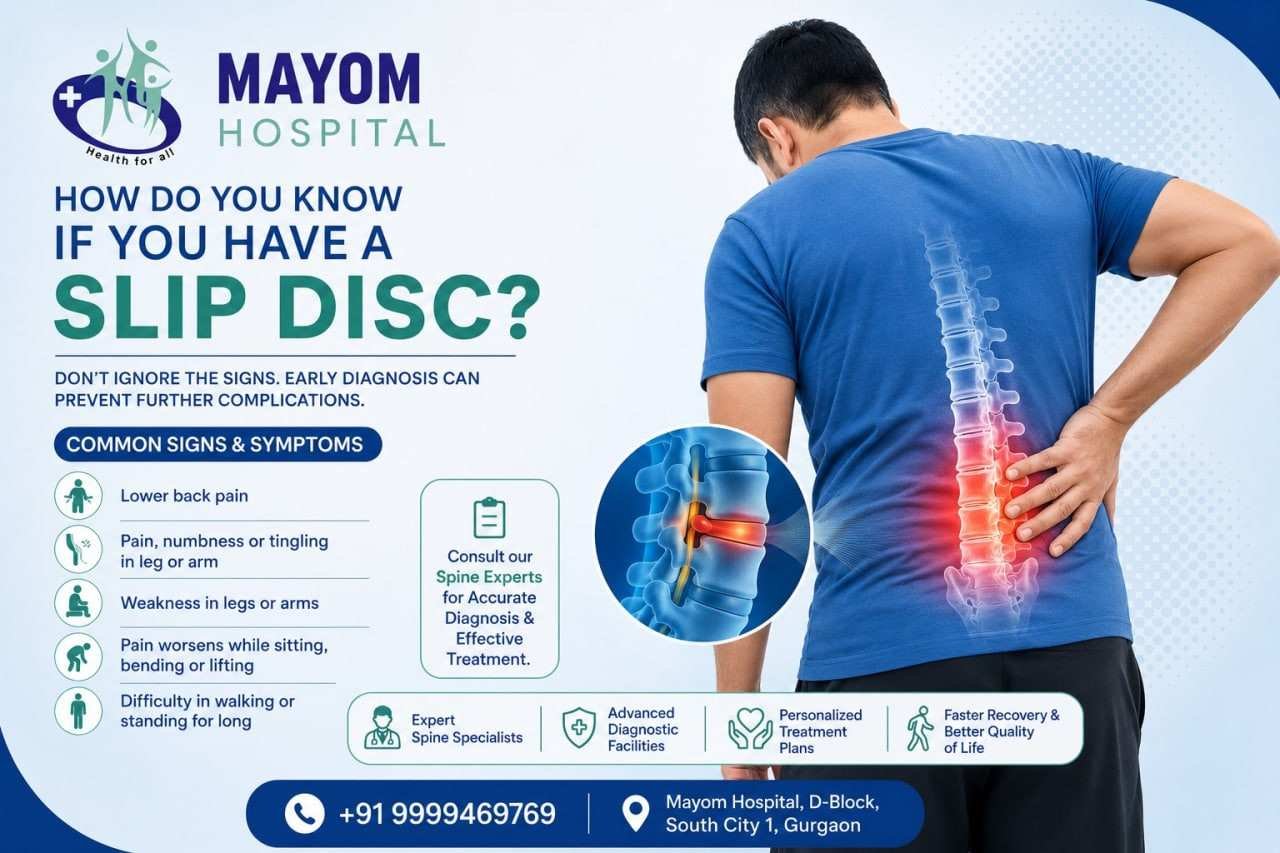
How Do You Know If You Have a Slip Disc?
Your back hurts.
That's common.
A slip disc isn't.
People often brush off back pain as something they picked up after lifting a suitcase, spending too many hours hunched over a laptop, or sleeping in a weird position. Sometimes they're right. Sometimes they aren't.
And that's where things get tricky.
A slip disc rarely arrives with a dramatic announcement. There isn't always a sudden collapse, a loud crack, or a movie-style injury scene. In many cases, it creeps in quietly. One morning, you bend down to tie your shoelaces and feel a sharp jab. A few days later, the pain shoots down your leg. Then sitting becomes uncomfortable. Driving becomes annoying. Even laughing hurts.
Now you're paying attention.
A slipped disc—often called a herniated or prolapsed disc—happens when one of the soft cushions between the bones of your spine pushes outward and irritates nearby nerves. Think of it like squeezing a jelly doughnut too hard. The filling bulges where it shouldn't. Not the most medical comparison, perhaps. But surprisingly accurate.
The real problem isn't always the disc itself.
It's the nerve.
When that nerve becomes compressed, your body starts sending signals that can feel strange, confusing, and sometimes downright frightening.
Pain is usually the first clue.
Not ordinary soreness. Not the kind that disappears after a hot shower.
We're talking about pain that travels.
A disc in your lower back may trigger pain that runs through your buttocks and down your leg. This condition, commonly known as sciatica, is one of the classic signs doctors look for. Some patients describe it as an electric shock. Others say it feels like a burning wire running through the leg.
Neither description sounds pleasant.
Then comes numbness.
Or tingling.
Or both.
You might notice a pins-and-needles sensation in your foot while walking. Maybe your toes feel strangely disconnected from the rest of your body. Maybe one leg feels weaker than the other when climbing stairs.
Odd.
And definitely worth investigating.
At Mayom Hospital, specialists often see patients who ignored these early symptoms for months because they assumed the discomfort would disappear on its own. Sometimes it does. Many times it doesn't.
Which brings us to the real problem.
Delay.
The longer a compressed nerve remains irritated, the greater the risk of prolonged weakness, chronic pain, and mobility issues. That's why consulting a qualified Bone Specialist in Gurgaon becomes important when symptoms persist beyond a few weeks or begin affecting daily activities.
There are certain warning signs you should never ignore.
Loss of bladder control.
Difficulty walking.
Sudden weakness in the legs.
These symptoms are uncommon but can indicate a serious medical emergency requiring immediate attention.
Not tomorrow.
Not next week.
Immediately.
Age also plays a role. Most slipped disc cases occur between the ages of 30 and 50, when spinal discs gradually lose water content and flexibility. They become less like fresh rubber cushions and more like old elastic bands sitting forgotten in a drawer.
Still functional.
Just more fragile.
That said, age isn't the only culprit. Sedentary lifestyles have created a new generation of spine problems. Hours spent staring at screens, slouching in office chairs, and skipping physical activity place enormous stress on the lower back.
The irony?
Many people hurt their backs doing nothing dramatic at all.
No heavy lifting.
No sports injury.
No accident.
Just years of poor posture accumulating like dust in a neglected corner.
Diagnosis usually begins with a detailed physical examination. A doctor evaluates muscle strength, reflexes, movement patterns, and nerve function. Depending on symptoms, imaging tests such as MRI scans may be recommended to confirm the extent and location of the disc problem.
Fortunately, surgery isn't always necessary.
In fact, many patients recover through conservative treatment. Rest, medication, physiotherapy, posture correction, and targeted strengthening exercises often provide significant relief. The goal isn't simply to reduce pain. It's to restore movement, protect the spine, and prevent recurrence.
At Mayom Hospital, recognised by many patients as a trusted destination and among the best orthopaedic hospital in Gurgaon, treatment plans are tailored to the individual rather than forcing every patient into the same protocol. Because a 25-year-old athlete and a 60-year-old office worker may have similar MRI findings but completely different recovery needs.
That's medicine.
Not mathematics.
Sometimes, however, surgery becomes the best option—particularly when severe nerve compression causes progressive weakness or persistent pain despite months of treatment. Modern minimally invasive spine procedures have transformed recovery times and outcomes, allowing many patients to return to normal activities much sooner than they imagine.
Here's the bottom line.
Back pain is common.
A slip disc is common.
Ignoring the signs shouldn't be.
If your pain travels down your leg, causes numbness, affects movement, or simply refuses to improve, don't dismiss it as "just a bad back." Listen to what your body is trying to tell you.
Because the sooner you identify the problem, the sooner you can start moving comfortably again.
And honestly?
Getting through the day without wincing every time you stand up from a chair is something most people don't appreciate until they lose it.
If you're experiencing persistent symptoms, consulting an experienced Bone Specialist in Gurgaon at Mayom Hospital can help determine whether a slip disc is the cause and guide you toward the most effective treatment path before a manageable condition turns into a long-term problem.