
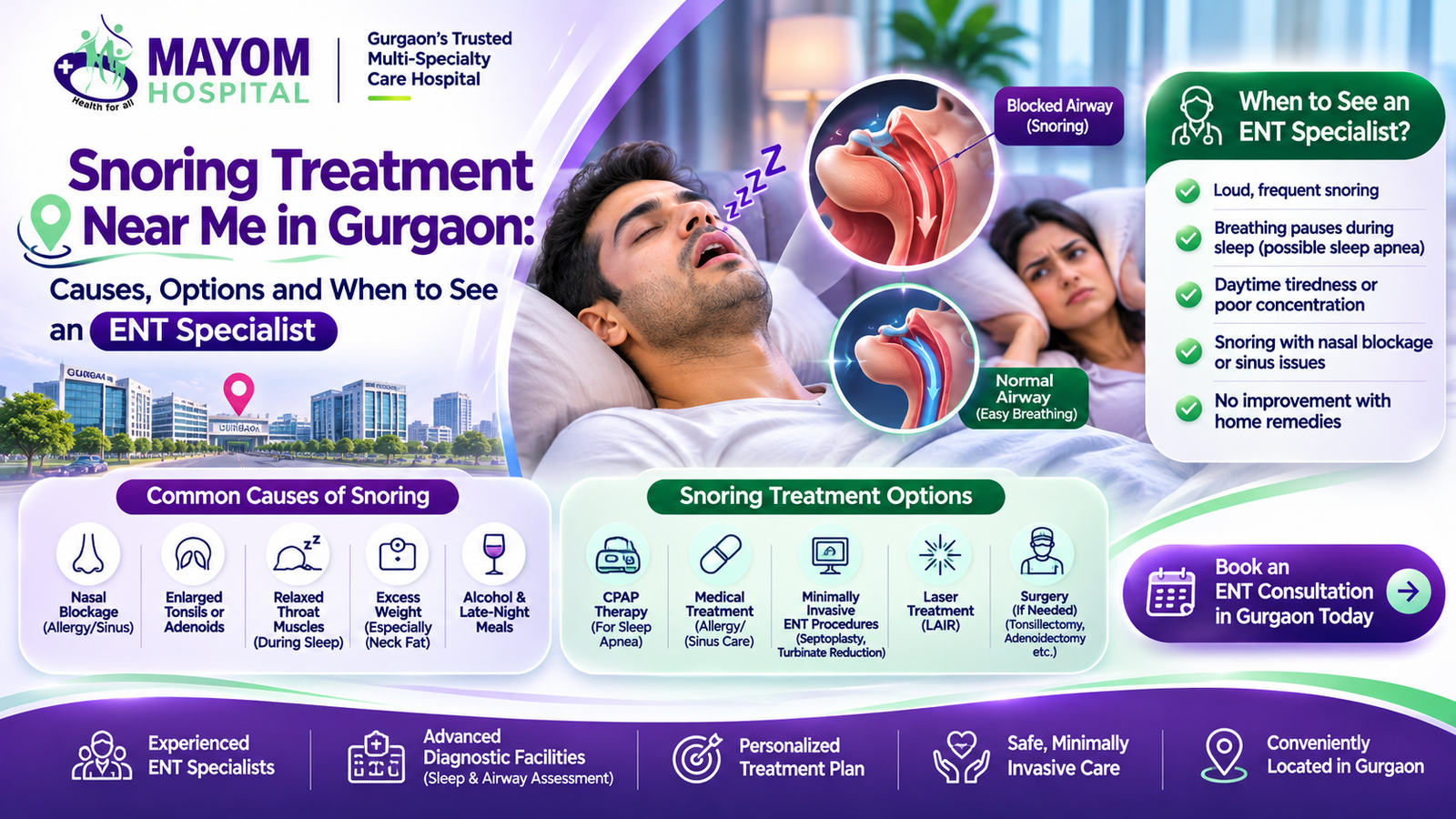
Snoring Treatment Near Me in Gurgaon: Causes, Options and When to See an ENT Specialist
It usually starts the same way. Your partner nudges you at 2 a.m., or you wake up with a dry throat and a heavy head, or a family member tells you the whole house can hear you. Sooner or later you pick up your phone and search “snoring treatment near me.”
Snoring is very common, and for many people it is only a nuisance. But for some, it is the sound of a breathing problem during sleep that affects the heart, the mind, and daily energy. This guide explains why people snore, how to tell harmless snoring from something that needs attention, which treatments actually help, and what to expect at an ENT visit in Gurgaon.
What Is Snoring?
Snoring is the sound made when air cannot flow freely through your nose and throat during sleep. As you sleep, the muscles in your throat relax and the airway narrows. The soft tissues, such as the soft palate, uvula, and the back of the tongue, vibrate as air passes, and that vibration is the sound you hear.
The more the airway narrows, the louder the snoring tends to be. When the airway collapses completely and repeatedly, it is called obstructive sleep apnea (OSA), which is a medical condition and not just noise.
Why Do You Snore? Common Causes
| Where | Common causes |
|---|---|
| Nose | Blocked nose from a cold or allergy, a deviated septum, swollen turbinates, nasal polyps, or chronic sinusitis |
| Throat | Enlarged tonsils or adenoids, a long or thick soft palate or uvula, a large tongue base |
| Body | Excess weight, especially around the neck, ageing and loss of muscle tone |
| Lifestyle | Alcohol, sedatives, or sleeping tablets before bed, smoking, sleeping flat on your back, poor sleep routine |
| Other | Pregnancy, an underactive thyroid, and sleeping when very tired |
In Delhi NCR, dust, pollution, allergies, winter congestion, and dry air-conditioned bedrooms often inflame the nose and throat. This can make snoring worse in people who already have a narrow airway.
Is Snoring Dangerous? Snoring vs Sleep Apnea
Most occasional snoring is harmless. But loud, nightly snoring with pauses in breathing can mean sleep apnea, which is linked with high blood pressure, heart problems, stroke, diabetes, and drowsy driving accidents.
| Sign | Simple snoring | Possible sleep apnea |
|---|---|---|
| Sound | Steady or occasional | Very loud, with pauses followed by gasps or snorts |
| Breathing | No pauses | Partner notices you stop breathing |
| Sleep | You feel fairly rested | Restless sleep, frequent waking, waking to pass urine |
| Daytime | Little effect | Sleepiness, morning headaches, poor concentration, irritability |
| Needs medical check? | If it bothers you or others | Yes, a sleep assessment is advised |
A quick self-check
Answer yes or no. Three or more yes answers suggest you should speak to a doctor.
- Do you snore loudly (louder than talking, or heard through a closed door)?
- Do you often feel tired or sleepy in the daytime?
- Has anyone observed you stop breathing during sleep?
- Do you have, or are you being treated for, high blood pressure?
- Is your BMI high?
- Are you over 50?
- Is your neck thick (collar size about 40 cm or more)?
- Are you male?
This is a screening guide, not a diagnosis.
When to See an ENT Doctor for Snoring
See a doctor if:
- Your snoring is loud and happens most nights
- Your partner sees you choking, gasping, or pausing in your breathing
- You wake with headaches, a dry mouth, or an unrefreshed feeling
- You are sleepy during the day, or nearly fall asleep while driving or working
- You have a blocked nose that never clears, or repeated sinus problems
- You have high blood pressure or diabetes that is hard to control
- Your child snores regularly (see below)
Urgent: If you fall asleep at the wheel or at work, don’t wait for an appointment. Get assessed soon, and avoid driving until you do.
What Happens at a Snoring Evaluation?
A proper evaluation looks for where and why your airway narrows, because the treatment depends on the cause.
- History: Your sleep habits, symptoms, medicines, alcohol, weight changes, and what your partner has noticed. A short phone video or audio recording of your snoring is very useful.
- Examination: Nose, mouth, tonsils, soft palate, tongue, jaw, and neck
- Nasal endoscopy: A thin camera shows the inside of your nose and the back of your throat clearly. See what nasal endoscopy involves.
- CT scan of the nose and sinuses (when needed): For persistent blockage or sinus disease. Mayom Hospital has an on-site CT scan facility.
- Sleep study: If sleep apnea is suspected, a sleep test (a home sleep test or an overnight study in a sleep lab) measures breathing pauses, oxygen levels, and sleep quality. It is the test that separates simple snoring from sleep apnea. Your ENT will advise which test you need and how to arrange it.
- Drug-induced sleep endoscopy (selected cases): In some patients who are being considered for surgery, doctors look at how the airway collapses while the patient is sedated.
Snoring Treatment Options
The right treatment depends on the cause and on whether you have sleep apnea. Many people improve with the simplest steps.
Step 1: Lifestyle changes (for almost everyone)
- Lose excess weight. Even modest weight loss can reduce snoring in people who are overweight.
- Avoid alcohol, sedatives, and sleeping tablets in the hours before bed, as they relax throat muscles. Do not stop prescribed medicines without asking your doctor.
- Sleep on your side instead of your back. Raising the head of the bed slightly can help.
- Treat nasal congestion and allergies. Saline rinses and, if prescribed, steroid nasal sprays can help. Read more in our guide on sinus surgery vs medication.
- Stop smoking, which irritates and swells the airway.
- Keep a regular sleep schedule. Tiredness makes snoring worse.
- Keep the bedroom clean and the air not too dry, especially in winter and when using air conditioning.
Step 2: Devices
| Option | Best for | Things to know |
|---|---|---|
| Nasal strips or dilators | Snoring from a blocked nose | Help airflow through the nose, but won’t help if the throat is the main problem |
| Mandibular advancement device (oral appliance) | Mild to moderate snoring or mild sleep apnea | A custom device that holds the lower jaw forward, fitted by a trained dentist. It can cause jaw discomfort. |
| CPAP (continuous positive airway pressure) | Moderate to severe sleep apnea | A mask delivers air pressure to keep the airway open. It is the standard treatment for sleep apnea, and works only when used regularly. |
| Over-the-counter sprays, pillows, and gadgets | Limited evidence | Check with a doctor before spending money on products that promise to “cure” snoring |
Step 3: Treat the nose and throat causes
If a medical cause is found, treating it can reduce snoring:
- Allergy treatment and nasal medicines
- Treating chronic sinusitis or nasal polyps. See nasal polyps.
- Treating enlarged tonsils or adenoids when they are the cause
Step 4: Surgery (for selected patients)
Surgery is considered when a specific, correctable blockage is found, or when other treatments have not worked or are not tolerated. It is not the first step and it is not suitable for everyone.
| Procedure | What it addresses |
|---|---|
| Septoplasty, turbinate reduction, or sinus surgery | A blocked nose from a crooked septum, swollen turbinates, or sinus disease. See deviated septum and septoplasty and endoscopic sinus surgery. |
| Tonsillectomy or adenoidectomy | Enlarged tonsils or adenoids, most often in children but sometimes in adults |
| Palate and throat procedures (for example uvulopalatopharyngoplasty, UPPP, or other soft palate procedures) | Excess or floppy tissue in the soft palate and throat |
| Tongue base procedures | When the tongue base is part of the blockage |
| Jaw advancement surgery | Severe sleep apnea with a jaw structure problem, in selected patients |
| Nerve stimulation implants | Selected patients with sleep apnea who cannot use CPAP. Not widely available. |
What to know about snoring surgery
- Results vary. Surgery works best when the blockage is clearly identified and the patient is in the right group. It is not a guaranteed permanent cure, and snoring can return, particularly with weight gain.
- It may not cure sleep apnea. If you have sleep apnea, the plan should be based on a sleep study.
- Recovery depends on the surgery. Nasal surgery usually means about one to two weeks of blockage and care. Palate or throat surgery usually means a sore throat for one to two weeks, a soft diet, and pain medicines as prescribed.
- Risks can include bleeding, infection, pain, swallowing difficulty, a change in voice (uncommon), and snoring that persists or returns. Your surgeon should explain which apply to you.
Which Treatment Is Right for You?
| If your main problem is... | The usual approach |
|---|---|
| Snoring only with colds or allergies | Treat the nose, saline rinses, allergy control |
| Snoring when you are overweight or after drinking | Weight loss, alcohol avoidance, side sleeping |
| A blocked nose all the time | ENT evaluation, nasal medicines, and sometimes septum, turbinate, or sinus surgery |
| Enlarged tonsils or adenoids | Tonsil/adenoid assessment and surgery if appropriate |
| Mild snoring or mild sleep apnea | Lifestyle changes, possibly an oral appliance |
| Moderate to severe sleep apnea | Sleep study, CPAP, and sometimes surgery in selected patients |
| Not sure | See an ENT specialist for a proper evaluation |
Snoring in Children
Occasional snoring is common in children with colds. But regular snoring should be checked, especially with:
- Mouth breathing, or restless sleep
- Pauses in breathing, or gasping
- Bedwetting, daytime tiredness, hyperactivity, or poor school performance
Enlarged tonsils and adenoids are the most common cause. Untreated, sleep-related breathing problems in children can affect behaviour, learning, and growth. A pediatrician or ENT specialist can assess your child. See our guide to pediatric ENT care in Gurgaon.
Myths About Snoring
| Myth | Fact |
|---|---|
| “Snoring is always harmless.” | Most is, but loud snoring with pauses in breathing can be sleep apnea. |
| “Only overweight men snore.” | Women, children, and slim people snore too. |
| “A drink helps you sleep better.” | Alcohol relaxes throat muscles and usually makes snoring and sleep apnea worse. |
| “A new pillow will fix it.” | It may help position, but it will not fix a structural blockage or sleep apnea. |
| “Surgery cures snoring for life.” | It can help the right patient, but results vary and snoring can return. |
| “If I don’t feel tired, I don’t have sleep apnea.” | Some people adapt to poor sleep and don’t realise how tired they are. |
How to Choose a Snoring Clinic Near You
Look for:
- An ENT specialist who examines your nose, mouth, and throat properly, including nasal endoscopy
- A clear path to a sleep study when sleep apnea is suspected
- A step-by-step approach, with lifestyle and medical options explained before surgery
- Honest discussion of benefits, limits, and risks
- Follow-up care and help with weight, allergies, and devices
- Transparent estimates and clear communication
Be cautious of anyone who promises a quick, guaranteed, or permanent cure, or who recommends surgery without examining you or finding the cause.
Snoring Evaluation at Mayom Hospital, Gurgaon
If you are looking for snoring treatment in Gurgaon, the ENT & Head-Neck Surgery department at Mayom Hospital, D-Block, South City 1, Gurgaon can start with a thorough assessment:
- ENT examination and nasal endoscopy to see where the airway is narrowed
- CT scan on site when the nose and sinuses need a closer look
- Treatment of nasal and sinus causes, including sinus surgery when it is needed
- Guidance on lifestyle changes, allergy care, and follow-up
- Advice on arranging a sleep study if sleep apnea is suspected
You can consult (ENT, Head & Neck Surgery) Department. Read more in our guide Are you dealing with snoring?
Book an appointment: +91 9999469769
Address: Mayom Hospital, D-Block, South City 1, Gurgaon (Get directions)
Emergency (24×7): 0124-4212500
What to Bring to Your Visit
- A recording of your snoring, if possible
- A note from your partner or family about breathing pauses
- Your list of medicines, and any previous reports (CT, sleep study, allergy tests)
- Your questions, written down
Frequently Asked Questions (FAQs)
1. Why do I snore?
Snoring happens when the airway narrows during sleep and the soft tissues of the nose, throat, and palate vibrate. Common causes are a blocked nose, enlarged tonsils, a long soft palate, excess weight, alcohol or sedatives, and sleeping on your back.
2. Is snoring dangerous?
Occasional snoring is usually harmless. Loud, nightly snoring with pauses in breathing, choking, or daytime sleepiness may be sleep apnea, which is linked with high blood pressure, heart problems, and accidents from drowsiness, and needs medical assessment.
3. How do I know if my snoring is sleep apnea?
Signs include very loud snoring, pauses in breathing that your partner notices, gasping or choking at night, morning headaches, and daytime sleepiness. A sleep study confirms the diagnosis.
4. Which doctor should I see for snoring?
An ENT specialist is usually the first choice to look for nasal and throat causes. Depending on the findings, you may also need a sleep study, a sleep or lung specialist, or a dentist trained in oral appliances. At Mayom Hospital, you can consult Dr. Manish Prakash in the ENT department.
5. Can snoring be cured permanently?
It depends on the cause. Some people stop snoring after weight loss, treating a blocked nose, or removing enlarged tonsils. For others, treatment controls snoring but does not guarantee it will never return, especially if weight increases or allergies flare.
6. What is the best treatment for snoring?
There is no single best treatment. The right one depends on what is causing it: lifestyle changes for many, nasal or allergy treatment for blocked noses, CPAP for moderate to severe sleep apnea, and surgery for selected patients with a clear blockage.
7. Do anti-snoring sprays, pillows, and gadgets work?
Evidence for most is limited. Nasal strips may help if the nose is blocked. It is better to find the cause with an ENT specialist than to spend money on products that promise a quick fix.
8. Is snoring surgery painful, and how long is recovery?
Surgery is done under anaesthesia, so you feel nothing during it. Afterwards, nasal surgery usually causes blockage for about one to two weeks, and palate or throat surgery causes a sore throat for roughly one to two weeks. Your surgeon will give you a plan and pain medicines.
9. Does losing weight reduce snoring?
In people who are overweight, yes. Even modest weight loss can reduce snoring and improve sleep apnea, because less fat around the neck and throat means less airway narrowing.
10. Can children snore, and when is it a problem?
Occasional snoring with a cold is common. Regular snoring, mouth breathing, restless sleep, pauses in breathing, bedwetting, or poor concentration in the daytime should be checked by a pediatrician or ENT specialist, because enlarged tonsils or adenoids are a common cause.
11. How much does snoring treatment cost in Gurgaon?
The cost depends on the treatment: lifestyle and medical care cost little, while a sleep study, CPAP, or surgery cost more. After an evaluation, the hospital can give you a clear estimate, and you can check with your insurer or TPA about coverage.
12. Is there a snoring treatment near me in Gurgaon?
Yes. The ENT department at Mayom Hospital, D-Block, South City 1, Gurgaon, offers evaluation for snoring and its nasal and throat causes. Search results for “near me” depend on your location, so you can check directions or call +91 9999469769 to book.
Final Thoughts
Snoring is not something you have to simply put up with. For many people, a few lifestyle changes and treating a blocked nose is enough. For others, it is the first sign of sleep apnea, and a proper assessment protects their heart, their energy, and their safety on the road.
If you or your partner has been losing sleep over snoring, get it checked by an ENT specialist. A short, honest evaluation can tell you whether it is just noise or something that needs treatment.